





















Multi-Tool vs MaxLift vs ATLS: Choosing Your Cargo-Handling Gear

A pocket-sized tool, a dedicated handheld tractor and an Argo power suit each have a place between the freight elevator and your next departure.
There is a particular moment in cargo hauling when the flying stops and the real work begins: the ramp is down, the freight elevator is up, and every container between them still needs moving. Your tractor equipment determines how much freedom you have to arrange that load, where you can stand and how much machinery you have to take with you.
The Greycat Multi-Tool, MaxLift and Argo ATLS all belong in that conversation. They are useful at different scales, and a regular hauler may sensibly carry more than one. An ATLS can make a busy hangar a much more enjoyable place to work without making the small tool on your suit redundant.
The Multi-Tool earns its place before the hauling starts
The Pyro RYT Multi-Tool needs a TruHold tractor-beam attachment to move objects. The tool alone is not enough. Its appeal is portability: you can bring it along for a delivery, a salvage trip or an excursion where moving an awkward object is only a small part of the evening.
That makes it the sensible everyday companion for a pilot who occasionally handles cargo but does not want every trip to revolve around loading equipment. It can also remain useful beside a larger loader, reaching a job from a different position or letting you finish a small task without climbing back into a vehicle.
A container that will not move is not necessarily stuck. Tractor tools have lifting limits, and a cargo-grid attachment or obstruction may also be involved. Repeatedly tugging from the same angle is unlikely to solve a problem caused by the wrong tool or a blocked route.
MaxLift keeps the operator on foot
Greycat’s dedicated MaxLift is the stronger handheld option. It suits players who expect to handle freight regularly but still want to walk around the loading area, board different ships and work without carrying a power suit. It is especially attractive when your ship does not have a convenient place for an ATLS.
The distinction is not simply small cargo versus big cargo. Access matters too. A handheld operator can change position around a ramp or hold without first finding room for an industrial frame. That freedom is valuable on mixed-purpose ships where a vehicle would compete with the freight you came to carry.
Current community documentation describes MaxLift lifting up to 16-SCU containers alone and two operators combining beams for up to 32 SCU. Treat those as container-size guidance, not a promise that every object of a similar size can be moved: the object, available access and current balancing still matter. If your regular work involves the largest containers, choose equipment around that load before accepting it.
ATLS changes the way a container reaches its destination
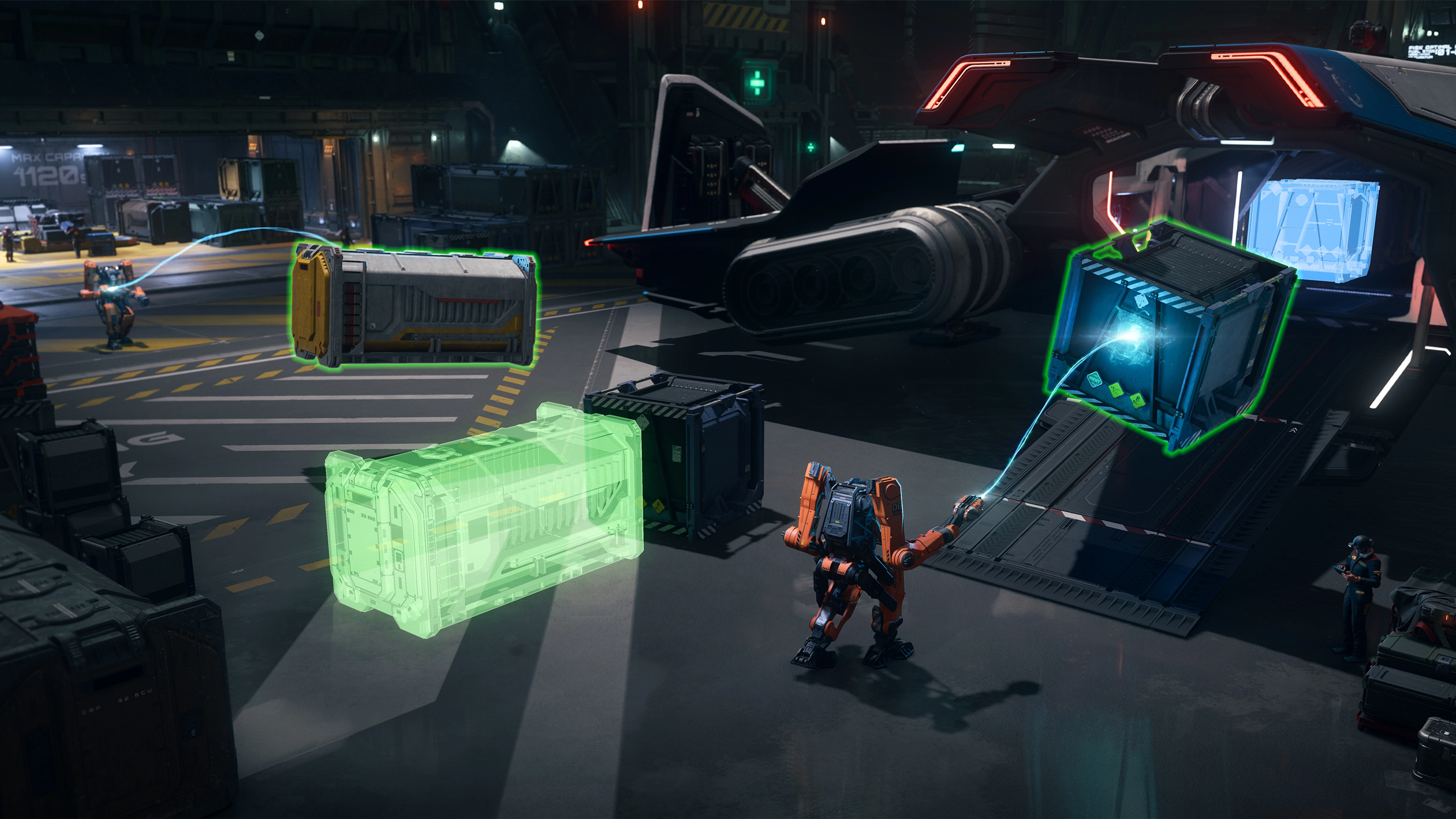
Argo’s loader does more than put a larger beam on a pair of legs. When it grabs cargo, the container comes into a holding position beside the operator. You then aim a placement hologram at the destination and send the container there. The preview distinguishes a cargo-grid position from a surface placement, helping the operator line up the next move.
That arrangement is particularly appealing during a long sequence of transfers between a freight elevator and a ship. The operator spends less attention shepherding every container along the whole route and more on choosing its destination. It is still worth keeping a clear path: a hologram does not make a ship’s ramp wider or remove cargo already occupying the hold.
The ATLS also has a throwing mode, while targeting ships or ground vehicles uses more conventional tractor handling so a small overturned vehicle can be rotated. Those are different tasks from neatly placing a consignment. Around a crew and a loaded ship, controlled placement is the useful habit.
Bring room for the loader, too
The standard cargo ATLS is a one-person ground vehicle, listed at 1.8 metres long, 2 metres wide and 2.8 metres tall. It has no cargo capacity of its own. Its open frame supplies no environmental protection, and it has no independent EVA movement. Your suit and the place you are working still matter.
For a hauler travelling between several destinations, the ATLS is another piece of equipment to transport. It must fit aboard the actual ship, through its access route and alongside the intended load. A nominal hold capacity is not enough to establish that fit. At a home hangar it can stay part of the loading operation; on a roaming cargo run it needs a place on the journey.
The container and the doorway matter as much as the lifting tool. Our SCU and cargo-access guide explains why a ship’s capacity does not promise that every box arrangement will fit. If you are collecting processed ore, the refinery collection guide covers the change from mining bags to a freighter’s cargo space.
What we would take on the next run
- Occasional cargo among other jobs: start with the Multi-Tool and the correct attachment. Keep the load within the equipment’s capabilities.
- Regular freight in a compact working ship: MaxLift offers heavier handheld handling without taking up vehicle space.
- Repeated loading in a hangar or a ship with room for it: the ATLS becomes much more persuasive. Its placement system is built for that repetition.
- A shared cargo operation: divide the work around access. One person can position containers at the elevator while another arranges the hold; everyone does not need the same tool.
A ship-mounted tractor is another option when your vessel has one. The Taurus and C1, for example, include dedicated loading equipment, while the Starlancer MAX does not. Picking a cargo ship and choosing its supporting tools are therefore parts of the same decision. The best arrangement gets the load aboard cleanly and leaves you looking forward to the flight that follows.