

























Consolidated Outland History: Silas Koerner, the Mustang and Beyond

Silas Koerner wanted a ship nobody else could build for him. Follow Consolidated Outland from its Mustang challenge to the employee-designed Nomad and the ambitious Pioneer.
Silas Koerner had the money to collect almost any ship he wanted. Apparently, that was not enough. Consolidated Outland began with a more demanding ambition: to build spacecraft that satisfied a founder who could find something wrong with everyone else’s work.
That gives the company a very different origin from an established naval supplier or a centuries-old industrial institution. Its story follows a wealthy enthusiast with unusually direct control over what reaches the factory floor. The Mustang, Nomad and Pioneer show how far that ambition has travelled.
From Bremen wealth to a ship of his own
Koerner was born in 2899 on Rytif, Bremen II, and inherited his family’s fortune. Investments across communications, fish farming, electronics, mining and other industries helped expand his business interests before spacecraft manufacture became his most personal project.
His interest in ships went well beyond transport. An extensive private collection included rare designs, and the desire to build his own ideal spacecraft eventually became Consolidated Outland. Despite the name suggesting a federation of interests, the company belonged to Koerner alone. He retained close involvement in design and production.
It is easy to recognise the enthusiast in that arrangement. Plenty of pilots have opinions about what a manufacturer should change. Koerner could walk into his own factory and demand it.
The Mustang challenges the established starter

The Mustang Alpha was intended to challenge the RSI Aurora with a distinct approach to a small civilian ship. Its light-alloy construction and sharply swept shape gave Consolidated Outland an immediately recognisable first spacecraft. This was not an attempt to make its newcomer disappear among the established brands.
The family then spread into different roles: the Beta for touring, the Gamma for racing and the Delta for militia use. That progression matters to the manufacturer’s story. The Mustang became a platform for different pilots rather than remaining a single expression of its founder’s taste.
Before the Mustang, the company had made cosmetic conversion parts for other ships. Moving from those attachments to an entire spacecraft was the decisive step: Koerner no longer had to improve somebody else’s silhouette.
The Nomad gives another designer a moment
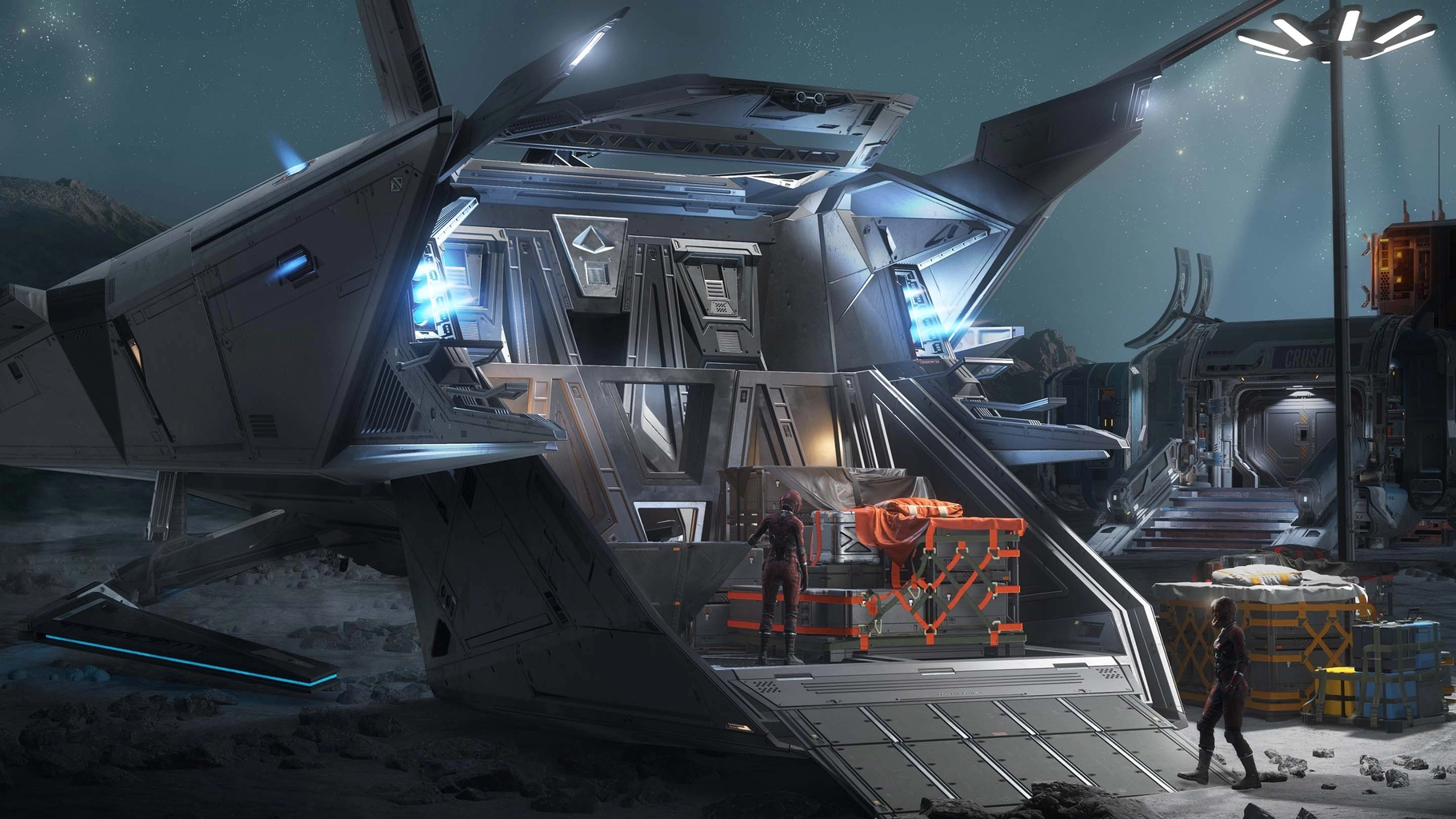
The Nomad introduces a welcome change to a story dominated by one personality. Its lead designer, Bix Bista, was a production assistant who submitted a design through a company-wide call for ideas. Koerner introduced Bista when he announced the ship.
That is a lovely piece of background for a spacecraft aimed at independent pilots. The design did not simply emerge as another instruction from the owner’s office. Someone elsewhere in the company had an idea, and it became a ship.
The result combines a solo cockpit and living space with a 24 SCU rear cargo bed. Its angular body and external freight arrangement look quite different from the Mustang. Consolidated Outland’s identity allows that variation: the Nomad does not need to resemble an enlarged starter fighter to belong to the same company.
For a player, it offers a practical connection to the lore. The cargo-oriented design gives the Nomad a daily purpose, while Bista’s story supplies a human detail that specifications alone would miss.
The Pioneer takes the ambition to another scale
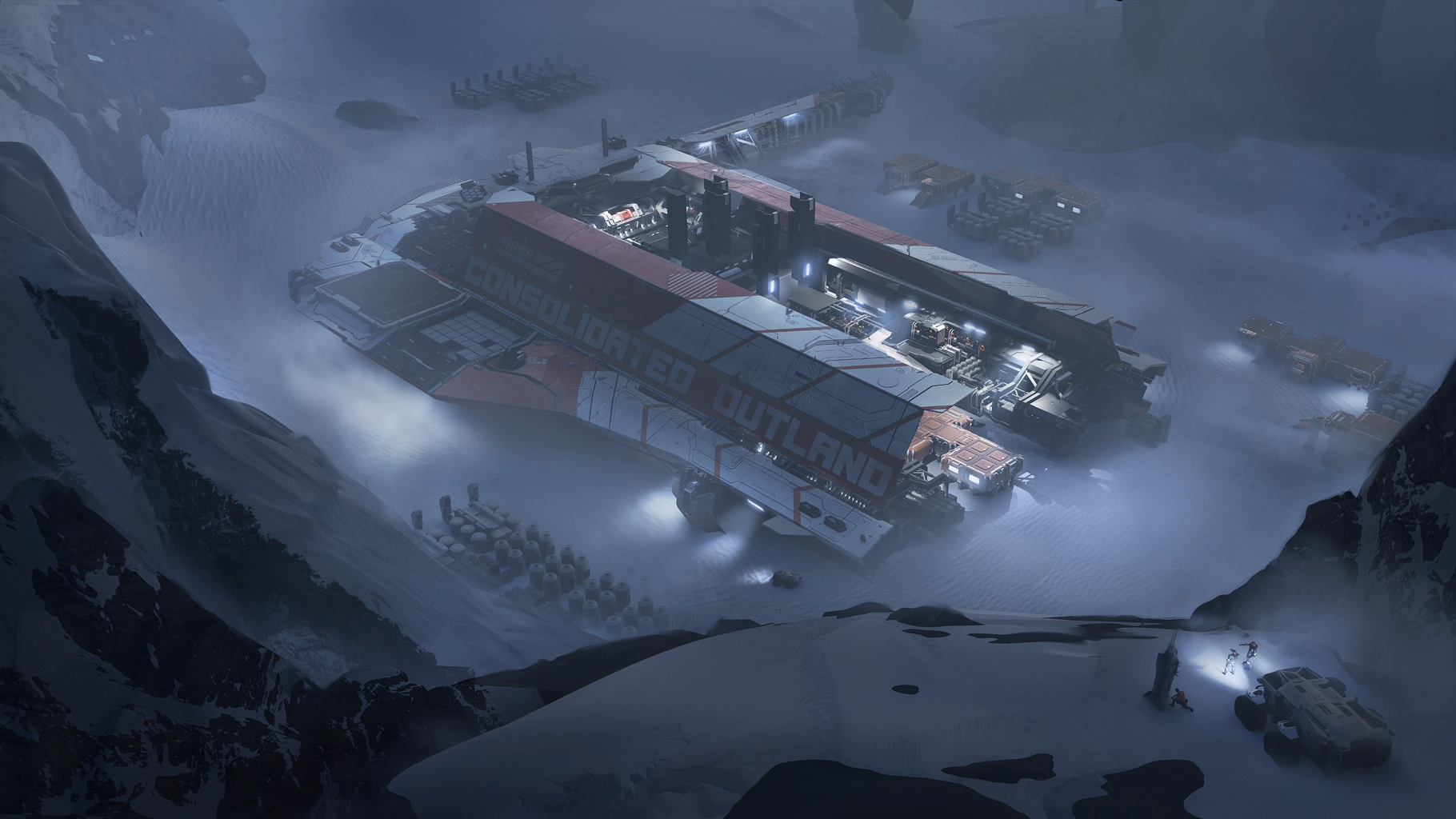
In the fictional chronology, Consolidated Outland introduced the Pioneer in late 2947. Its purpose moves beyond carrying one pilot or a modest load: it is conceived as a mobile construction platform, with manufacturing and assembly capabilities for establishing homes and bases.
That is an enormous change of scale from a Mustang. The current vehicle page lists the Pioneer as in development, so this part of the story concerns its intended role. Its place in the lore should not be mistaken for a claim that a player can currently take one out and begin building.
The contrast is what makes the company worth following. A small ship for getting started, a solo freighter born from an employee’s idea, and an ambitious construction vessel all express different ways of setting out independently. They are not interchangeable stages of one compulsory progression.
A manufacturer with room for different dreams
The Mustang family remains the clearest introduction to Koerner’s original challenge. The Nomad makes a stronger case for a pilot whose independence involves freight and a place to live. The Pioneer belongs to a much larger future ambition, with development still separating that ambition from everyday use.
Consolidated Outland is at its most interesting when those differences are allowed to stand. There is no need to force every hull into a single visual formula. The company’s history is already held together by the people who wanted to make something of their own.