

























Golem vs Prospector vs MOLE: Which Mining Ship Fits Your Crew?

A bare-bones Drake miner, a self-contained MISC prospector or three Argo mining stations: the choice starts with how you want to work, and who is coming along.
A Prospector pilot can spot a promising deposit, settle the ship in front of it and start working without leaving the seat. A MOLE pilot can bring three mining lasers to the same rock—but needs people at those stations to use them. That difference is easy to overlook when the larger ship’s capacity catches your eye.
The Drake Golem, MISC Prospector and Argo MOLE all offer a proper mining career. The choice is how much flexibility you want in the equipment, how you prefer to handle ore and who will actually be aboard. For a newcomer, the Golem keeps the machinery straightforward. For a committed solo miner, the Prospector offers more freedom to tune the ship. For friends who enjoy working together, the MOLE makes the mining itself a shared job.
Golem or Prospector for a solo miner?
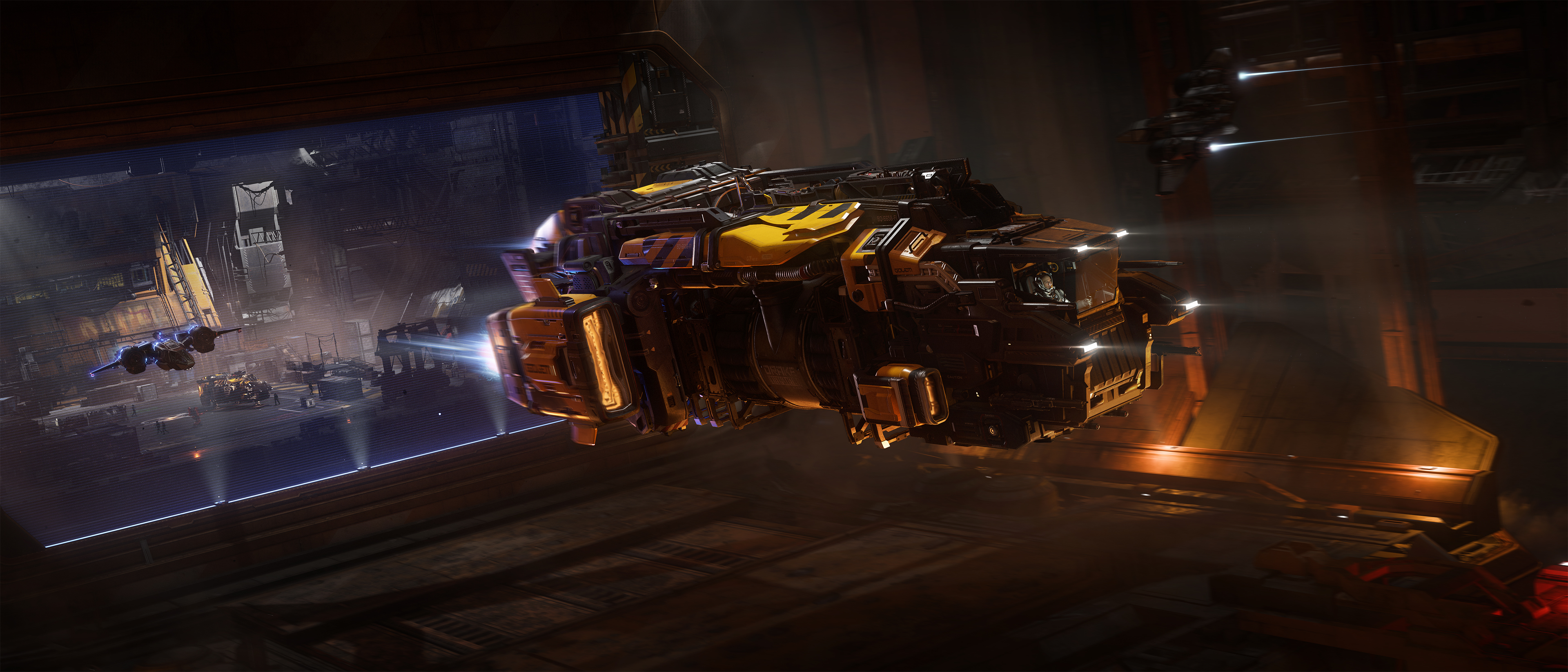
The Golem looks like something a mining settlement would keep running long after the paint had worn away. There is a cab, a retractable mining arm and a pair of exposed ore containers; Drake has left out the walk-through cabin and living quarters. You can keep personal equipment in the external locker near the cab, but this is a machine to take out to work, rather than a small home among the asteroids.
Its fixed mining head has two module slots and works with mining gadgets. You can adjust its behaviour, although you cannot replace the head with a different model. That is the meaningful limitation for someone who enjoys tailoring a loadout: a rock that would suit another head may be a reason to move on.
The Prospector gives that same lone pilot a swappable head and onboard living space. Its appeal grows as you learn which deposits you want to pursue and what sort of laser behaviour you prefer. More options also mean more decisions; buying a different head is only useful if its characteristics suit the rock and the rest of your equipment.

Raw laser power is only part of breaking a deposit cleanly. Resistance affects how readily energy enters the rock, while instability makes controlling that energy more difficult. A powerful beam can help with a stubborn deposit, yet a more manageable charge can be the better tool for keeping the fracture under control. The Golem’s substantial power does not make the Prospector’s flexibility redundant.
Once a deposit fractures, extraction and storage take over. Both ships keep the pilot in charge of the whole sequence, which is exactly what many players want after logging in alone. You can leave when you please, choose another area without coordinating a crew and finish a run when your own evening ends.
The Golem OX is a different ship
The OX uses the Golem’s cab but replaces the mining arrangement with a broader cargo platform and a tractor beam. It is a hauler, not a Golem that can switch between freight and mining. If you are choosing a first mining ship, make sure you are comparing the base Golem.
What changes when you bring a MOLE crew

There is a particular pleasure in bringing an industrial crew together: the pilot holds position while the miners work their separate arms, call the charge and decide when to extract. The MOLE is built for that arrangement, with three independently operated mining stations and a listed crew of four. It turns the same deposit into a cooperative job.
The pilot does not operate the mining lasers from the flight seat. A lone owner can move between piloting and a mining station, but then cannot reposition the ship without returning to the cockpit. Nor can one person switch on all three lasers and leave them running: an occupied station is needed to operate each one.
That makes a two-person MOLE workable in a different way from a fully crewed one. One person flies while the other mines, with more storage available than on a small solo ship. They are not getting three active heads from two players. With a pilot and three miners, the ship can use all of its mining stations together.
Different heads across the arms give a crew room to combine their equipment around the deposits they intend to work. Coordination still matters. Three beams are not an invitation to pour energy into every rock indiscriminately; the operators need to react to the same charge rather than work as if each has a separate target.
The MOLE also gives its crew a shared interior and accommodation. Friends looking for a regular evening aboard one ship may value that more than the independence of a small fleet. An organisation can build a larger operation around the same arrangement, but the ship does not require an organisation to make sense.
Ore capacity, containers and the trip home
| Ship | Factory ore capacity | Mining arrangement | Crew fit |
|---|---|---|---|
| Golem | 32 SCU, in two 16 SCU pods | One fixed head; two module slots | One pilot; no walkable living space |
| Prospector | 32 SCU, in four 8 SCU pods | One interchangeable head | One pilot with living quarters |
| MOLE | 96 SCU of ore storage | Three separately occupied mining stations | Four listed crew: pilot plus three miners |
These are factory ore figures, not a promise that every customised ship has the same capacity. They also exclude the reserve-container totals used in older marketing. A Prospector does not carry 128 SCU of ore at once simply because that number appears in an early description, and the equivalent old 288 SCU figure for the MOLE is not its carried ore capacity.
Recco Battaglia’s rewards now include ore-pod blueprints alongside other mining equipment. That adds a progression route beyond the factory setup. The fitted pods and their compatibility matter when comparing a customised ship with a stock one; an upgraded example should not silently become the specification for the entire model.
Golem pods use standard 16 SCU container dimensions and can attach to cargo grids, but their ship attachment is not interchangeable with the Prospector’s or MOLE’s pods. They hold mined material rather than ordinary freight. Removing them involves unlocking the ports and using a tractor beam; there is no emergency pod-jettison button.
Neither the Prospector nor the MOLE refines ore onboard. The mining run therefore leaves a further job: getting the material to a refinery and collecting the processed cargo. More ore storage can reduce return trips, but it also leaves a larger load to deal with. If the crew enjoys mining far more than transport, sharing that later work can be as useful as adding another laser.
Keep persistence separate from capacity
Alpha 4.10 added ore and commodity containers to long-term persistence, with an important distinction: ore pods supplied with ships use item recovery, while in-game-purchased pods can preserve their contents through that persistence system. Do not assume that every factory pod protects its ore in the same way. This concerns retention between builds, rather than increasing what the ship can hold.
One larger ship, or several small ones?
For a regular solo miner, the Prospector remains the most flexible choice of these three. You keep full control from one seat and have room to change equipment as your interests develop. The Golem is attractive if you want a smaller, simpler industrial ship and are happy to work within its fixed-head design.
For a pair, there is a genuine choice between sharing a MOLE and flying separate miners. Two small ships let each pilot reposition, select deposits and return independently. The MOLE keeps both players together and offers more ore capacity, while leaving only one person mining if the other remains at the controls. Choose the arrangement you enjoy sharing, rather than assuming the larger hull must be the next step.
A regular group of three or four has a stronger reason to consider the Argo ship. Its stations give miners distinct jobs, and a dedicated pilot can keep them in position. For a group whose attendance varies from night to night, keeping a small miner alongside the MOLE is useful: nobody has to abandon a mining evening because the rest of the crew cannot make it.