



























Meet the RSI Polaris: Crew, Hangar and Life Aboard

From its militia origins to its fighter hangar, medical bay and crew quarters, explore how the RSI Polaris works as a shared warship and what ownership involves.

The Vanduul attack on Vega in 2945 exposed a problem for the UEE: it needed a warship that could respond quickly without committing an Idris frigate. RSI’s answer carried capital-ship torpedoes, a fighter hangar and the facilities to keep a crew deployed. The Polaris would serve the Navy, but civilian militias were part of its purpose from the outset.
The released Polaris combines four torpedo tubes with bunk rooms, a mess, an armoury and a medical bay. Its enclosed hangar carries a fighter, and onboard stores can supply repairs, fuel and ammunition when that craft returns. Those facilities give the crew somewhere to sleep, treat casualties and maintain an escort between engagements.
Flight readyRSI military corvette
A warship for the Navy and the militia
The Polaris’s civilian role was written into its original commission.
In the ship’s lore, the aftermath of Vega accelerated work on a smaller first-response vessel. The UEE wanted something suited to patrols, rescue work and local security, with enough striking power to contribute to a larger fleet action. RSI’s proposal combined a torpedo battery with a hangar: one ship could threaten a heavy opponent while carrying a smaller craft for work beyond the corvette.
The Militia Mobilization Initiative brought that design into civilian hands in the in-universe year 2946. A local defence force could use a Polaris as its flagship, while the Navy could assign it to patrol and picket duties. Cargo storage and medical facilities support those longer deployments, carrying supplies and providing treatment away from port.
The real development history began with the 2016 concept reveal. By December 2022, CIG was showing a revised interior built around larger components and more usable rooms. The familiar angular hull remained, but the internal arrangement had been substantially reworked.
The flight-ready version arrived in 2024. Its release Q&A documented an enlarged armoury, bunk-room accommodation, a larger forward turret and changes to torpedo reloading. The executive officer’s quarters had been removed, with that space given to the armoury.
Inside the design
The 2022 interior walkthrough
CIG’s Finding the North Star walkthrough, from 8:27, follows the planned interior from the bridge towards the hangar and engineering spaces. The walkthrough predates the released ship and still includes the subsequently removed executive officer’s room.
Life aboard: bunks, mess and duty stations
Crew share bunk rooms, with washing facilities, personal storage and a communal mess.

Crew accommodation
Shared quarters and the mess
Broad tables and fitted seating fill the mess, with food preparation along one wall. The crew can eat together here, away from the bridge and weapons stations.
The bunk rooms provide shared sleeping accommodation and storage for personal equipment. Corridors and deck changes connect these living spaces to the hangar, medical bay and duty stations; moving around the Polaris takes more than stepping out of the cockpit.
The bridge and crew complement
The pilot flies the corvette, while its armament is distributed across other stations. CIG’s release configuration describes a five-person bridge arrangement alongside the manned turrets and separate torpedo controls.
RSI lists a complement of twelve. That is not a minimum for moving the ship between ports: combat demands more people because the turrets, torpedo controls and embarked fighter operate separately.
The armoury and brig
The expanded armoury gives an armed crew a dedicated equipment space. The brig contains two holding cells and a monitoring station, reflecting the corvette’s security role. These rooms sit alongside medical and cargo facilities within a fixed interior.
The Polaris is not modular. You cannot exchange the brig for more bunks or turn the medical room into extra freight capacity. Nor does the presence of holding cells, by itself, establish a complete prisoner-capture and delivery mission loop.
A medical bay for the crew and recovered casualties
Four Tier 2 beds give the Polaris useful treatment and regeneration facilities.

Treatment has limits
The medical bay has four Tier 2 beds and a monitoring station. Tier 2 treatment covers minor and moderate injuries; severe injuries still require Tier 1 care.
Its beds also support regeneration. Set the ship as your regeneration location, keep the bed operational and replenish its MedGel. RSI’s medical guidance gives Tier 2 beds an 8,000 km regeneration range. Being outside that range, losing the bed or exhausting the required MedGel can send you back to your home location instead.
A fighter pilot or ground team can use the corvette as a regeneration location while it remains within range. MedGel belongs on the supply list alongside the fuel, ammunition and repair materials needed elsewhere aboard.
The hangar: a fighter aboard a torpedo corvette
A carried craft can work independently while the Polaris supplies transport and support.
What is meant to fit
CIG’s release Q&A identifies the Aegis Sabre as the design reference for the hangar. The launch presentation also shows and names the RSI Scorpius.
The embarked fighter can launch to escort another ship or engage a smaller opponent while the Polaris stays at range. Recovering it into the enclosed bay lets the corvette transport it to the next destination and replenish its supplies.
Space to land and leave
Multi-ship loads need more care. Each craft must clear the opening, land securely and depart without another hull blocking it. A tightly packed bay also leaves less room for people and equipment.
The Sabre-sized design brief provides a reference for choosing a carried craft; other combinations need individual clearance checks. Fighters shown in promotional images are not necessarily included with a Polaris pledge.

Repair, refuel and rearm
Ship Hangar Services, introduced in Alpha 4.8, includes the Polaris among its supported hosts. A suitable landed craft can request repairs, hydrogen and quantum fuel, ballistic ammunition, missiles and countermeasures. Its pilot stays seated and uses the mobiGlas vehicle-maintenance app.
This is a later capability than the manual-only servicing described in the Polaris’s 2024 Q&A. The hangar can now support a visiting ship, provided the host carries the necessary stock.
The cargo that makes servicing possible
Service resources must be on the Polaris’s cargo grid. Repairs consume Recycled Material Composite, usually shortened to RMC; refuelling and rearming need the appropriate fuel and ordnance. The documented repair request is all-or-nothing, so insufficient RMC prevents it completing.
Missile size and type matter when replenishing a partially occupied rack. Our Ship Hangar Services guide covers the supply requirements and service checks in detail.
Torpedoes, turrets and the people operating them
The Polaris is designed to threaten large ships while defending itself against smaller attackers.

Four launch tubes
28 Size 10 torpedoes
Each launch tube is supplied by a seven-round rotary feeder, giving the ship 28 Size 10 torpedoes in its fitted magazines. The weapons occupy a substantial internal space, with a dedicated control position and access to the mechanisms from inside the hull.
CIG describes the Polaris as a long-range threat to larger ships, particularly when their defences have been compromised. Point-defence weapons can intercept the torpedoes, so escort ships that distract or suppress those defences can help the salvo reach its target.
The release Q&A also allows manual replenishment using a Multi-Tool tractor beam and additional torpedoes carried aboard. Spare rounds occupy cargo space in addition to the 28 torpedoes in the fitted magazines.
The forward gun and turret coverage
The nose turret mounts two bespoke Size 6 ballistic guns. Four other manned turrets cover the upper hull and sides, with remote weapons supplementing them.
The forward turret gives its gunner a direct-fire weapon against heavy targets, separate from the torpedo battery.
Automatic point defence
Seven point-defence cannons provide an automated layer of protection. In CIG’s documented targeting order, incoming hostile ordnance takes priority over nearby hostile vehicles.
Point defence reduces some of the crew’s workload, but it does not replace the manned turrets or an escort. The Polaris’s release Q&A explicitly distinguishes its long-range striking role from close-quarters brawling.
Cargo and engineering occupy much of the ship
A fighter, a medical bay and a torpedo battery all draw on the supplies brought aboard.
Capital components need room
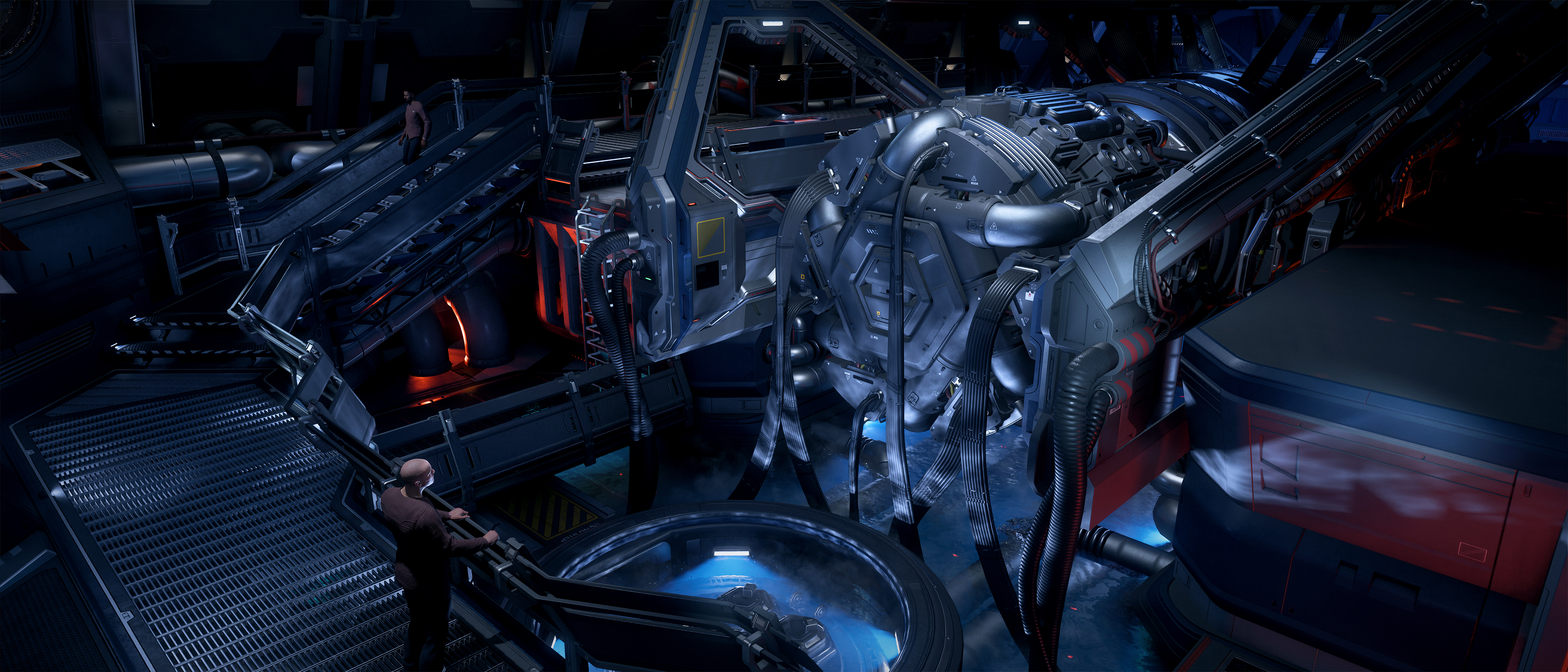
The engineering spaces show why the interior grew during development. Large machinery occupies the aft section, with access platforms and components spread across more than one level. Capital-class power and shielding require considerably more physical space than the equipment rooms aboard a small combat ship.
The aft machinery spaces are well away from the bridge. Their access platforms and multiple levels account for part of the distance a crew member must cover when moving through the hull.
Large docking ports on both sides provide station access. The hangar remains the route for an embarked fighter, while the cargo bay has its own loading access and internal handling equipment.
Freight shares space with the ship’s stores
The hold can carry ordinary cargo, but a deployed Polaris also needs room for service commodities and spare ordnance. Filling it with freight leaves less capacity for supporting the fighter or replenishing the torpedo magazines.
CIG describes the lower bay primarily as a cargo area. Ground vehicles may fit, but it has not supplied a universal vehicle-capacity guarantee. An improvised garage also competes with the boxes and access routes needed for other work.
Why published cargo figures differ
RSI’s current Ship Matrix lists 620 SCU and dimensions of 181 × 87 × 40 metres. The 2024 launch specification gives 576 SCU and 166 × 82 × 35 metres in the landed configuration; those older figures remain common in guides.
The published references disagree. Use the current matrix as RSI’s present specification, but check the in-game cargo grid or clearance you need before planning a load to its limit. The difference between the pages does not, on its own, prove a particular hull or cargo-bay rework.
Is the Polaris right for your group?
Crew availability and the cost of keeping a capital ship supplied matter as much as its weapons.
For a regular multicrew group
For a group running military patrols or organised combat, the combination is compelling: Size 10 torpedoes for heavy targets, a fighter for escort work and four medical beds for casualties. The hangar’s servicing facilities let the fighter return for supplies without a separate trip to port.
Those capabilities consume different stores. A group using the full ship will need to account for torpedoes, service commodities and MedGel, as well as the corvette’s own fuel and repairs.
For one pilot or an occasional pair
A solo pilot can move the Polaris, but leaves its manned weapons unoccupied. With two people, the second player must choose between a gun station, torpedo controls, the fighter and work elsewhere aboard.
For a player whose friends join only occasionally, the Polaris is better suited to those organised group sessions than everyday solo combat. Its facilities remain accessible with a small crew, but much of its fighting capability depends on occupied stations.
A complete Polaris pledge
The Impound’s Polaris Standalone Ship is a complete CCU’ed pledge: the upgrades have already been applied and the Polaris is the final ship. The listing provides LTI and 10 Years insurance choices, subject to the selected variant’s availability.
The collection also separates Original Concept offers and editions with named extras. Pledge history and included cosmetics are purchase details; they do not change the standard Polaris’s hangar, medical bay or weapon stations.
Upgrading a ship you already own
The separate Upgrade to Polaris is an unapplied CCU. You need the compatible starting pledge specified by the selected option in your RSI account before you can apply it.
Compare the selected offer’s contents and insurance. Do not assume that a fighter shown in artwork, a paint, or Star Citizen game access is included unless the listing says so. A complete CCU’ed ship and an unused upgrade are different purchases.
Frequently asked questions
Crew requirements, medical facilities, hangar support and buying a Polaris.
Is the RSI Polaris flight ready?
Yes. The Polaris is a flyable ship, released in 2024. It is not a concept purchase awaiting its first playable release.
Can one person fly and fight in a Polaris?
One person can pilot it, but its torpedo controls and manned turrets are separate jobs. A solo pilot cannot use all of that armament at once or remain at the helm while attending another room.
How many crew does it need?
RSI currently lists twelve people. The practical number depends on how many stations you intend to use together, whether you launch a fighter and who remains available for work elsewhere aboard. The listed complement is not a universal minimum.
Which fighter is the hangar designed for?
CIG names the Aegis Sabre as its design reference and shows the Scorpius in the release presentation. Other combinations need individual clearance checks; physically squeezing several ships inside does not guarantee convenient loading or departure.
Does buying a Polaris include a fighter?
A fighter is included only if the selected offer explicitly lists one. The hangar and promotional artwork do not establish pledge contents.
Can the Polaris repair and refuel a carried ship?
Yes. It supports Ship Hangar Services, using the relevant resources on the host’s cargo grid. The receiving pilot must be landed, seated in the craft and authorised to use the host.
Can you regenerate aboard it?
Yes, using its Tier 2 medical facilities. Set the regeneration location and keep the bed working and supplied with MedGel. The published Tier 2 range is 8,000 km.
Can the medical bay heal every injury?
No. Tier 2 beds treat minor and moderate injuries. Severe injuries require Tier 1 treatment.
How many torpedoes does it carry?
Its four seven-round feeders hold 28 Size 10 torpedoes. Additional rounds carried as cargo are separate from that fitted magazine capacity.
Can its rooms be changed like modules?
No. CIG explicitly describes the Polaris as non-modular. Its medical bay, cargo space, brig and accommodation are fixed facilities.
Why do some specifications say 576 SCU and others 620 SCU?
The 2024 launch sheet gives 576 SCU; RSI’s current Ship Matrix lists 620 SCU. Those references disagree. For a load close to the limit, check the current in-game grid rather than relying on either published number alone.
Is a Polaris CCU the same as a complete CCU’ed ship?
No. An unapplied CCU requires the compatible base pledge named by the option you select. A complete CCU’ed Polaris already has its upgrades applied and is delivered with the Polaris as the final ship.
Find a Polaris for your fleet
Compare complete ships, Original Concept offers and upgrades from a compatible pledge.
Check the selected offer’s contents, insurance and availability before ordering.