



























RSI Zeus Mk II: ES, CL and MR Compared

Compare the Zeus ES, CL and MR through their interiors, crew stations and specialist equipment, from the ES’s living space to the MR’s planned capture role.
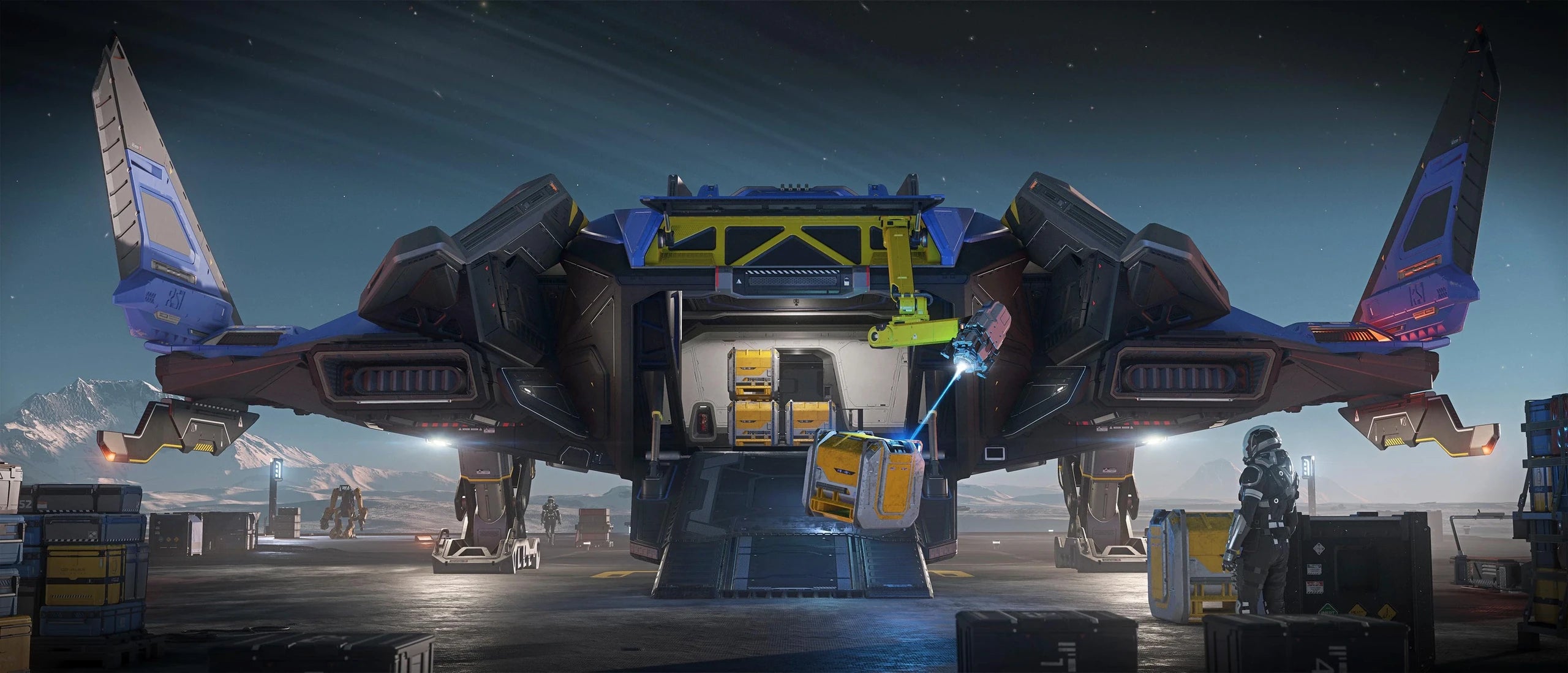
The Zeus Mk II puts three seats behind its pointed canopy, then changes much of the ship behind them. The ES leaves more room for the crew. The CL pushes the cargo hold forwards. The MR plans to fit an armoury and prisoner storage into the same broad, triangular hull.
The interior layout determines how much space remains around the bunks, what the other people on the bridge can operate and whether the ship’s main attraction is something you can use today.
ES & CL: flight readyMR: in development, not flight ready
The name that brought quantum travel to civilians
RSI’s modern ship recalls a much earlier turning point in Star Citizen’s history.
In the lore, the original Zeus reached the civilian market in 2140. It was the first commercially sold spacecraft equipped with a quantum drive, following decades in which the technology had been developed for military use. Its arrival helped people travel beyond Earth in far greater numbers.
Early prototypes suffered hull-integrity problems, and RSI sought help from Navy test pilot Michelle Saleno. She and the 999th Test Squadron helped overhaul the hull; Saleno completed the successful test flight in 2137, three years before commercial release.
The Mk II preserves the recognisable wedge of that earlier ship while widening the body to accommodate a larger living area. The ES carries the historical exploration connection most directly. Its full name, Essential, sits alongside the freight-focused Clipper and the security-oriented Marque.
The game’s development followed a much shorter timetable. CIG revealed the Mk II family in 2023, and the ES and CL became flyable in Alpha 3.24.2 in October 2024. The MR remains in development.
From the canopy to the crew rooms
The Zeus keeps its working stations together at the front, with accommodation and freight farther aft.
Three people on one flight deck
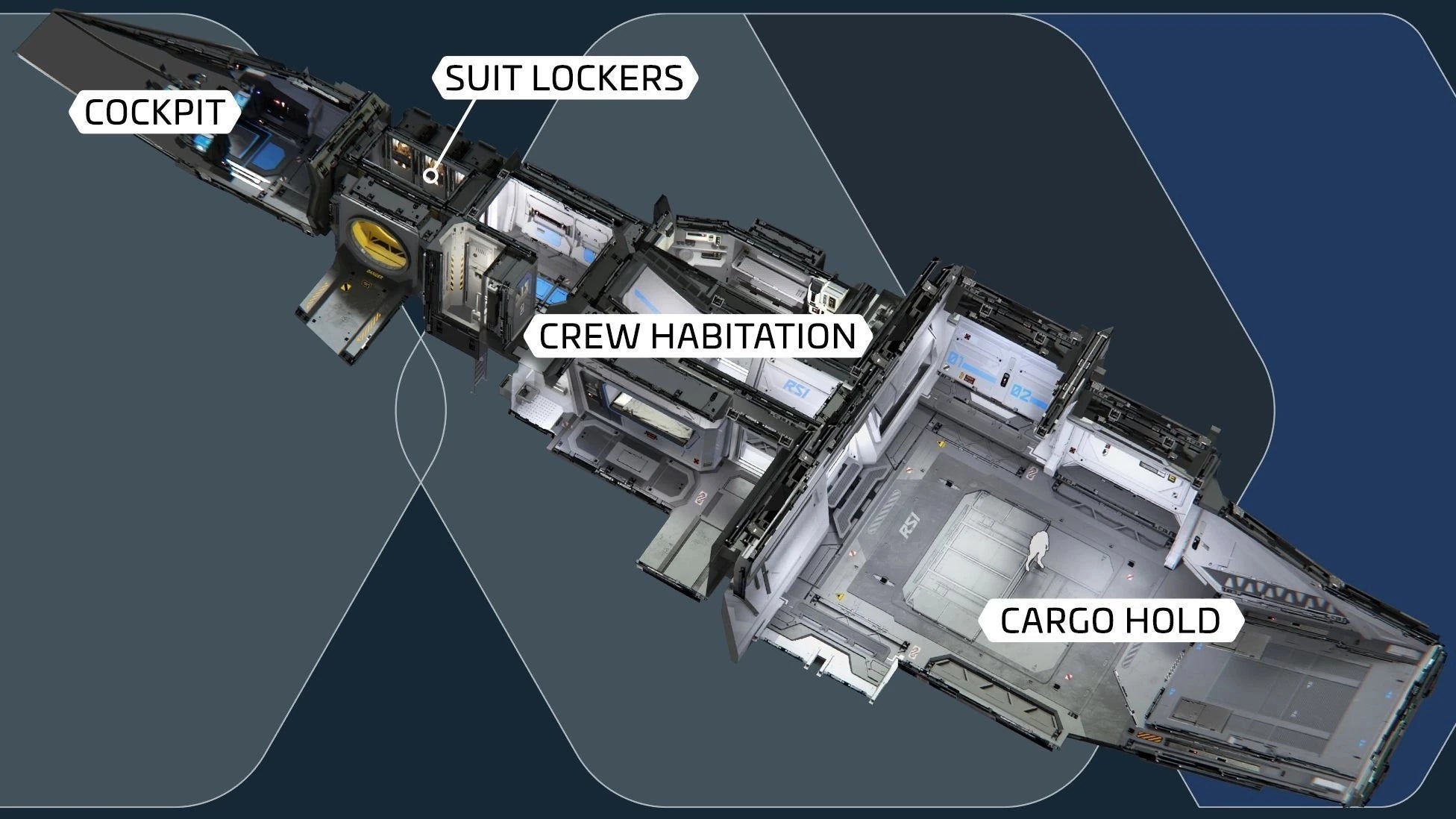
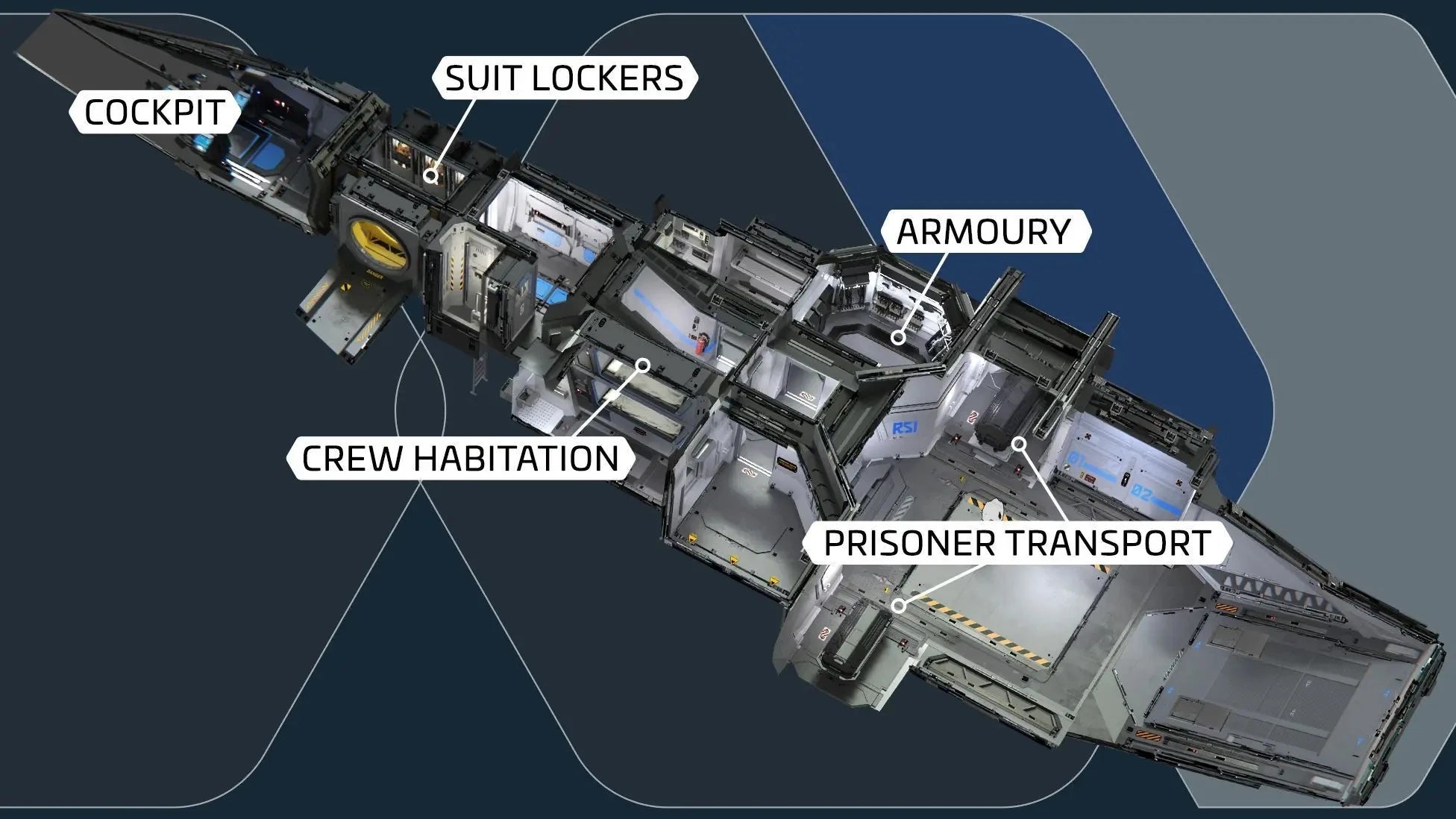
The pilot sits forward beneath the narrow canopy, with the co-pilot and gunner behind. Unlike a ship with a separate manned turret compartment, the Zeus lets its gunner remain on the bridge. The remote turret is operated from a seat rather than by climbing into the gun mount.
Behind the cockpit are spaces for suits and personal equipment. The airlock and ground-access ladder provide ways aboard away from the rear ramp. The arrangement is particularly useful on the CL: a full cargo hold need not be the route into the flight deck.
A bunkroom, kitchen and washroom
The crew sleeps in a shared three-berth room. The kitchen and dining area sit across the passage, with washing facilities nearby. There are no separate captain’s quarters: the person flying the ship uses the same accommodation as the rest of the crew.
In the ES, that living area has more room to spread along the hull. The CL shortens it to extend the hold. Both retain the shared bunkroom, kitchen and washroom.
The limits of a compact interior
The Zeus has no dedicated medical bay or shuttle hangar. Its sleeping berths do not provide medical regeneration, and the rear hold is shared space for whatever freight or suitable ground transport the owner brings.
For two or three friends, the attraction is having the accommodation and bridge stations within one manageable ship. A group wanting private cabins, onboard treatment or an independently deployable shuttle needs a different layout. Those facilities cannot be added simply by choosing another Zeus variant.
Zeus ES: more room for exploration and the crew
Essential is the family’s exploration model, with a smaller hold and a stronger shield installation.
What the ES keeps
The ES carries 32 SCU on its cargo grid, a quarter of the CL’s capacity. That still gives it a useful hold for supplies and smaller freight jobs, while preserving the larger living area. A player who spends more time travelling, landing and leaving the ship than moving full manifests has less reason to surrender that space.
RSI’s published equipment listing gives the ES four shield generators, against three in the CL. It also lists a different radar: Lephari for the ES and Surveyor for the CL. Shield count alone does not determine survivability; generator specifications and the rest of the ship’s equipment also matter.
Buying an explorer today
The exploration role is central to the ES’s design, but a larger radar does not by itself provide a complete discovery career. Do not buy it on the assumption that naming newly found systems, selling survey data or every proposed scanning feature is already part of its gameplay.
We would choose the ES for a personal travelling ship with occasional company, provided 32 SCU covers the freight you actually carry.
For the shorter specification reference, see our Zeus ES guide.
Zeus CL: the hold takes priority
The Clipper fits four times the ES’s cargo capacity into the same family of hulls.
128 SCU behind a smaller living area
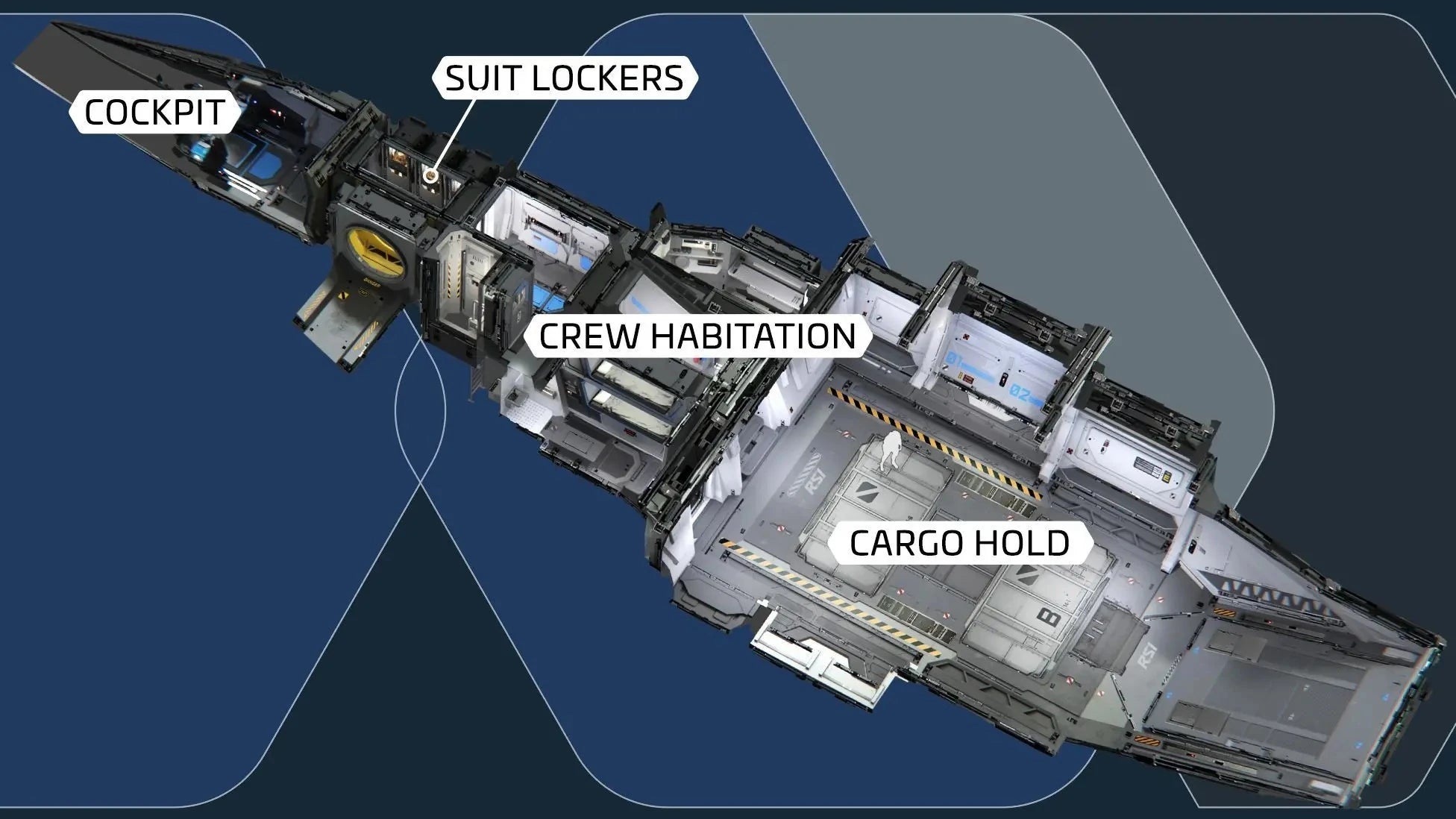
The CL’s advantage is substantial if freight is the ship’s regular work. A 64 SCU consignment already exceeds the ES’s grid, but occupies half the CL’s advertised capacity.
A load totalling 128 SCU will not necessarily fit the CL’s grid. Container dimensions and the shape of the available grid matter. Mixed loads can use spaces that a row of large boxes cannot, while freight left loose in an aisle should not be counted as extra supported capacity.
A tractor beam for the loading bay
The rear tractor beam distinguishes the CL from the ES. It gives the co-pilot a cargo-handling role separate from the gunner’s ventral turret. The beam can move freight through the ramp opening; it does not remove the need to position boxes within the grid.
When the extra hold is worthwhile
Choose the CL when cargo is a frequent job and the smaller kitchen and dining area are an acceptable trade. If most trips carry only personal equipment and a little freight, you may prefer the ES’s allocation of space.
Our Zeus CL overview covers the basic specifications. For the choice against Crusader’s freighter, read C1 Spirit versus Zeus CL.
Zeus MR: a planned ship for pursuit and capture
The Marque changes both the equipment outside the hull and the rooms within it.
Quantum dampener, EMP and turrets
The MR is planned around two complementary systems. A quantum dampener is intended to prevent a nearby target from entering quantum travel; an EMP is intended to disrupt ship systems. CIG’s design Q&A explicitly distinguishes the dampener from a quantum snare. The MR is not promised the ability to pull passing ships out of quantum travel.
The proposed second remote gun turret gives the co-pilot an additional combat station. The original plan assigns one turret to each of the two seats behind the pilot. CIG also discussed allowing several seats to operate the EMP and dampener, but that remains a design intention, not a confirmed live control scheme.
Armoury and prisoner transport
The concept layout adds an armoury and a dedicated area for prisoner pods. These rooms explain why the MR’s planned cargo capacity falls to 16 SCU: much of the hull is assigned to the people and equipment involved in capture work.
That makes the MR a more specific fleet choice than either released variant. A crew interested mainly in conventional ship combat should weigh whether it wants to wait for these capture facilities, rather than choosing the MR simply because it has another turret.
What an MR owner can fly now
As of November 2026, the MR is not flight ready. RSI’s loaner matrix assigns it a Zeus Mk II ES. The loaner is temporary and its assignment can change; it does not supply the MR’s proposed EMP, dampener or prisoner facilities.
The loaner matrix is useful before choosing an unreleased ship. Treat the MR’s illustrated interior and proposed equipment as development plans, with final behaviour still dependent on the ship and the associated gameplay systems.
Which Zeus fits your fleet?
Compare the ES’s accommodation, the CL’s freight capacity and the MR’s planned capture equipment.
ES or CL for a ship to use now
For mixed travel with a small crew, we favour the ES when the smaller hold is enough. It keeps more space for accommodation and has the stronger published shield installation. If hauling is the main reason for owning the ship, the CL’s much larger hold is the more useful compromise.
Their common pilot armament does little to separate them: both use two Size 4 forward guns. Choosing the CL does not turn it into a substantially better gunship, and choosing the ES does not remove the need for a gunner to operate its remote turret.
MR for a specific future job
The MR makes sense for someone deliberately building towards multicrew interdiction and prisoner transport. It is a poor substitute for an ES or CL that you want to use for its own role immediately.
Neither released variant requires three players merely to take off. The extra seats matter when jobs overlap: a pilot cannot keep flying while also leaving the bridge to attend something elsewhere. A regular second player can take turret or loading work; a third allows more of those jobs to happen at once.
Frequently asked questions
Variant choice, crew size, cargo and what an unreleased MR purchase means.
Are the Zeus ES, CL and MR all flight ready?
The ES and CL are flyable. They arrived in Alpha 3.24.2 in October 2024. The MR remains in development and is not flight ready.
What do ES, CL and MR stand for?
Essential, Clipper and Marque. Their roles are exploration, freight and security/interdiction respectively.
Is the Zeus modular?
These are separate variants with different interiors and specialist equipment. There is no released system for swapping an ES into a CL or MR by changing a role module. A pledge upgrade is a different process from an in-game refit.
Can one person fly a Zeus?
Yes. The ES and CL can be flown alone. Their three-seat bridge gives a crew additional stations; it does not make a three-person crew mandatory. A solo pilot still cannot occupy the remote gunner station and pilot the ship simultaneously.
Which variant has the most living space?
The ES devotes more of its interior to habitation. The CL retains a bunkroom, kitchen/dining area and washroom, but shortens the living section to enlarge its hold. The MR concept uses additional space for security equipment and prisoner storage.
Can every 128 SCU load fit on the CL’s grid?
No. Total volume is only part of the fit. Individual container sizes and the grid arrangement decide whether a particular consignment can be secured. The headline figure does not guarantee room for every combination of large containers.
Does the ES have the CL’s tractor beam?
No. The rear cargo-handling tractor beam is a CL feature. The ES retains its exploration-focused equipment instead.
Does the MR have a quantum snare?
No. CIG specifies a dampener, intended to block quantum departure nearby. A snare performs a different interception function. The MR’s equipment remains planned rather than usable aboard a live MR.
What is the Zeus MR loaner?
RSI currently assigns the Zeus Mk II ES. This is a temporary substitute, not a second ship permanently included with the MR. Loaner assignments can change.
Do the Zeus beds work as medical beds?
No. Sleeping accommodation is not a treatment or regeneration facility. None of these Zeus variants is specified with a dedicated medical bay.
Does buying a standalone Zeus include game access?
Do not assume it does. Check the selected listing’s contents for a game package. A standalone ship, an unused upgrade and a package containing game access are different purchases.
What is the difference between a CCU and a CCU’ed Zeus?
An unused CCU requires the compatible starting pledge named by its option. A complete CCU’ed Zeus has already had the upgrades applied, with that Zeus variant as the final ship. Neither wording changes whether the target variant is flight ready.
Compare Zeus ships and upgrades
Browse the variant that suits the job, then check the individual pledge’s contents.
A complete ship pledge
The ES, CL and MR Standalone Ship listings are complete CCU’ed pledges with the upgrades already applied. Insurance choices and availability vary by selected option. The MR remains unreleased.
Upgrading a ship you already own
An unused upgrade needs the exact starting pledge named in its selector. Check that requirement before buying; a similar ship name is not enough. Our CCU application guide explains the process.