




























Meet the Anvil Liberator: Exploration and Life Aboard

How Anvil fitted a small fleet into the Liberator: its open flight deck, separate crew and passenger spaces, 400 SCU hold, and the limits that matter for exploration.

The Liberator began with an awkward design problem: carry several spacecraft, keep room for ground vehicles, and still fit the whole carrier through a hangar door. At CitizenCon 2951, CIG’s designers showed how those competing demands produced its broad hull, open flight deck and lower garage. A military hovercraft was one of their starting references.
The resulting ship gives a small group a way to move its own fighters, working craft and vehicles over long distances. For an expedition, the Liberator would transport the smaller craft and their supplies, leaving mining, scouting or surface travel to the vehicles aboard. Inside, accommodation is divided between the carrier crew and the people travelling with their vehicles.
In developmentNot flight ready
How Anvil made room for a small fleet
The Liberator’s shape grew out of the vehicles it had to carry.
When CIG revealed the Liberator on 9 October 2021, it presented ship hauling as a career in its own right. The carrier would transport smaller vessels to places their own fuel capacity made difficult to reach. Anvil’s familiar military design language suited the job: broad ramps, substantial engine housings and a deck arranged around its payload.
In the presentation, the designers placed three landing-pad volumes inside a maximum hull envelope. The height of a parked ship mattered as much as its footprint. One early proposal would have become uncomfortably tall once the craft above it were included; another looked too far removed from the rest of Anvil’s range.
The eventual double-deck arrangement changed the original brief. Two XS pads remained on top, while the forward position became a smaller XXS pad. Garages occupied the lower level. The resulting layout has room for two XS craft above and a smaller craft at the front.
CIG’s in-universe introduction describes the Liberator as a civilian carrier using the long-distance capabilities associated with military transports and pathfinders. For a player group, that means moving several short-range craft together without organising a capital-carrier crew. The published two-person complement applies to operating the Liberator itself.
Life aboard: crew quarters and passenger spaces
The original interior separates the people running the carrier from the pilots and drivers it transports.
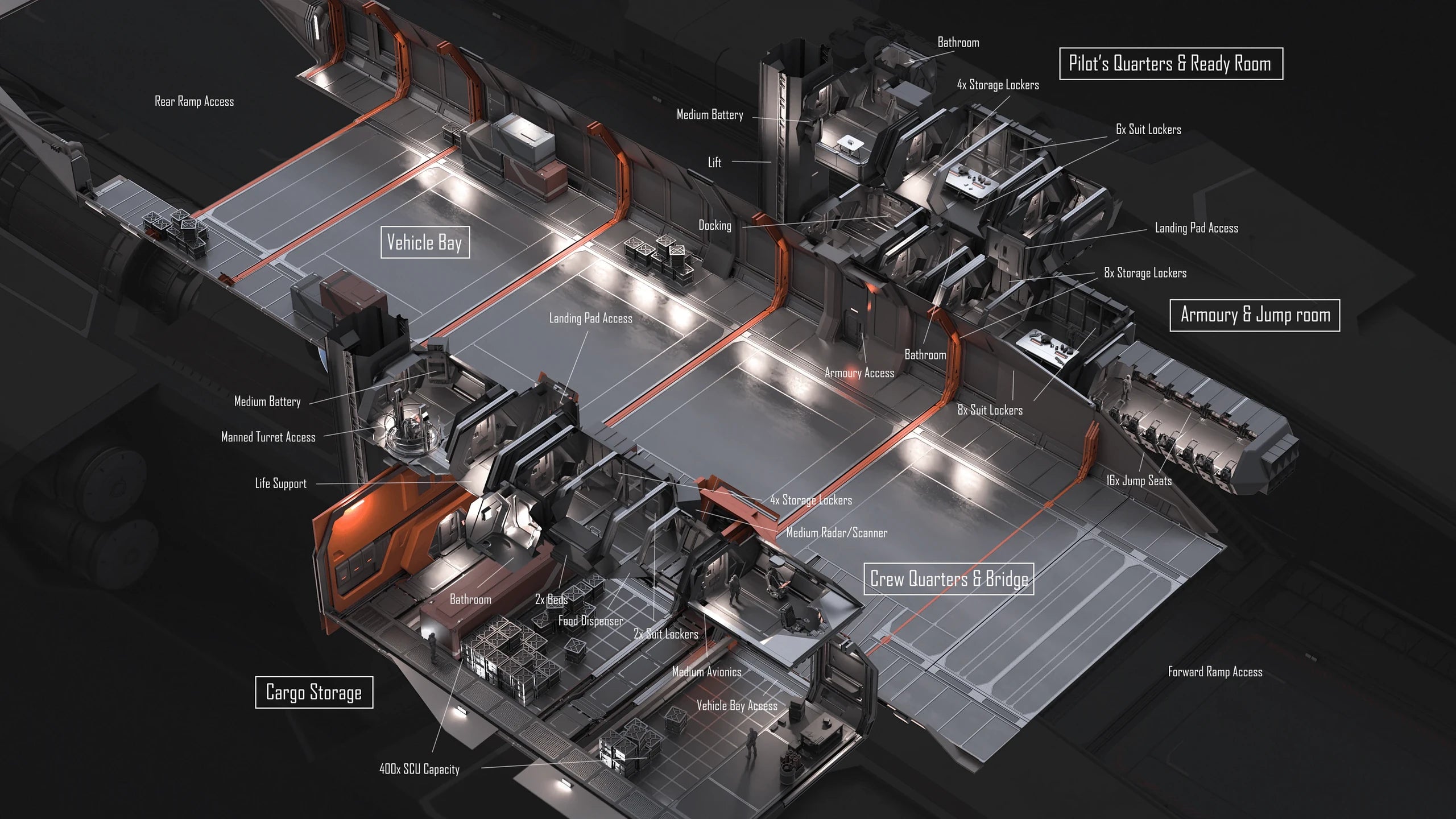
Two beds beside the bridge
The carrier’s own living area sits beside its bridge in the concept cutaway. The drawing labels two beds, a bathroom, food dispensers and suit lockers. Storage and working equipment occupy the surrounding spaces. This is compact accommodation for the pair operating the ship, with their sleeping and eating facilities close to the flight stations.
The bridge is offset from the central vehicle deck. CIG’s introduction describes a view across all three landing pads, a useful position for a crew whose passengers may be arriving in several different spacecraft. The crew area also connects with the garage and the ship’s technical spaces.
A ready room for the embarked pilots
Across the vehicle bay, the concept gives travelling pilots their own ready room, with a table, storage and suit lockers, a bathroom and access towards the landing pads. A separate armoury and jump room provides further lockers and rows of jump seats. The arrangement allows vehicle crews to prepare near their transport without occupying the carrier’s bridge.
The drawing identifies only two beds, both for the carrier crew. Additional passenger berths have not been confirmed, so the ready room does not yet answer where the embarked pilots would sleep on a long journey.
Moving through the ship
From the garage to the flight deck
The 2021 presentation describes full-height lifts for crew and passengers, plus stairs beside the ramp. The designers wanted a direct route from the living spaces to a waiting vehicle, and a separate route into the machinery spaces used by the ship’s crew. This matters on a carrier: most of the embarked players need to reach their own craft, rather than report to another station aboard the parent ship.
That circulation plan has continued to evolve. The May 2026 monthly report specifically records an interior revision for quicker access to the landing pads. The old cutaway therefore explains the arrangement and its purpose, but it is not a final construction plan.
Watch the original interior discussion from 30:11 in CIG’s CitizenCon 2951 Ship Talk. The following cargo discussion shows how the designers found space for freight without giving up a garage position.
What the pads and garage are designed to carry
The two upper pads and the smaller forward pad accommodate different classes of craft.

Two upper pads
Fighters and small working ships
CIG’s designer Q&A places the two upper pads in the XS size category. Its examples include the Anvil Hornet and Arrow, Aegis Sabre and MISC Prospector.
A group could use one upper pad for a Prospector and the other for an escort. The Prospector would do the mining, with the Liberator carrying it between locations, bringing supplies and providing a place to land. Its design does not include a confirmed refinery.
The smaller forward pad
The forward position uses the XXS envelope, with the Argo MPUV and Origin 85X named in the Q&A. It cannot be treated as a third equivalent fighter pad. The same smaller ship category applies to the garages, alongside ground vehicles up to the size of the Nova and Ballista.
These are the original design examples. A newer variant, altered landing gear or a different hull shape needs its own compatibility check when the Liberator becomes playable.
The garage below
The lower vehicle bay gives the carrier a surface role as well as an airborne one. The concept includes forward and rear ramp access, with the living spaces arranged along the sides. Ground vehicles can travel inside while ships occupy the upper pads; the dedicated cargo allocation remains separate from both.
The Q&A also allows for driving vehicles onto the upper deck, but identifies a specific weakness: damage to the ramp or door could prevent it operating, leaving the rear ramp as the loading route until repairs.
Capacity limits
Oversized ships are a separate question
CIG did not endorse one larger ship spanning both upper pads as an official loading arrangement. Even if a larger hull fits across the deck, supported spawning and transport remain unconfirmed.
For the shorter specification reference, see our Liberator overview.
400 SCU of cargo, with limits on servicing
Dedicated cargo bays leave the garage and landing pads available for vehicles.
How the cargo hold found its place
The designers originally expected freight to occupy part of the garage or one of the landing positions. During concept work, an alternative arrangement created dedicated cargo storage. CIG retained it, removing the need to trade a vehicle position for every load of supplies. The presentation’s cutaway shows the hold alongside the main vehicle bay.
The published 400 SCU refers to this secured internal cargo space. SCU is Star Citizen’s standard cargo-capacity unit. Extra boxes placed in the garage or on a pad are outside that allocation, and the Q&A does not promise them the same cargo-securing support.
Basic servicing was the original plan
The Q&A describes manual refuelling, repairs and rearming using supplies carried in the cargo bay. It expressly excludes dedicated servicing facilities and separate service stores.
Servicing supplies would share the hold with freight. How much work a crew could complete away from port will depend on the repair and servicing systems delivered with the ship.
Exploration equipment comes with the fleet
A group interested in surface exploration could carry ground vehicles below and suitable small craft above, changing its equipment without changing the carrier. The ship itself has no confirmed dedicated cartography room, science laboratory or exploration-drone suite.
A medical bed or regeneration facility has not been confirmed either.
Range and protection
The original design gives the Liberator substantial hydrogen and quantum fuel capacity relative to ships of its size, with a Size 3 quantum drive. CIG describes a long-range transport intended to move smaller craft between systems. It has not supplied a dependable expedition duration or a final fuel-consumption figure.
The Q&A says the carrier’s shields would not fully cover parked ships. It describes medium-to-heavy armour to compensate for relatively sparse weapons. The proposed manned turret, point-defence turrets and missiles provide defence, while embarked fighters could launch directly from the open deck.
From the 2021 concept to active production
Work during 2026 has included an interior revision and the move into detailed ship art.
The interior changes in 2026
By May 2026, CIG had picked up pre-production work and scheduled the start of whitebox, the early stage used to establish the ship’s spaces and proportions. The team also revised the interior to improve access to the landing pads.
Greybox and detailed art
The September report, published on 7 October, says greybox work had wrapped up, with a formal review due in early October. Large areas had already progressed into LOD0, the detailed art stage. The report targeted late October for that phase to finish; it did not announce a LIVE release patch.
The final interior, vehicle clearances and servicing facilities are still subject to development.
Before release
The current loaner ships
CIG’s loaner matrix currently lists the Ironclad Assault and F7C-M Super Hornet for Liberator owners. These are temporary allocations while the Liberator is unavailable, and may change. They are not permanent companion ships included with the finished carrier.
Who the Liberator is for
Its strongest case is a group that wants to keep flying several small ships together.
For a group with its own small fleet
The Liberator makes sense when the vehicles are central to the activity: friends flying their own fighters, a working ship travelling with an escort, or a group taking ground vehicles to a remote surface location. The carrier supplies the long-distance journey and the place to carry those vehicles together. Its separate cargo hold means useful freight capacity need not disappear when the garages are occupied.
The two-person carrier crew is an appealing starting point for a regular pair, with friends joining as pilots and drivers. Someone still needs to run the transport while those craft are away. A player who enjoys moving ships and supplies has a substantial role aboard; a group whose members all want to leave in their own vehicles may find the arrangement less convenient.
When an explorer is a better fit
If the aim is for everyone to share one ship’s bridge, accommodation and specialist exploration facilities, a dedicated explorer is a more direct fit. The Liberator spends much of its volume carrying other vehicles. Passenger sleeping arrangements and medical facilities remain unconfirmed.
The two-person specification covers the carrier itself. Loading, maintenance and flying the embarked craft add work for the wider group; how much one player can manage will depend on the finished systems.
A complete CCU’ed Liberator
The Impound’s Liberator Standalone Ship is a complete pledge whose upgrades have already been applied. It lists LTI and 10 Years insurance options. You receive the Liberator as the final ship; you do not need to supply a starting ship to complete that upgrade.
CCU’ed and Original Concept describe different pledge histories. Neither changes the carrier’s development status, and artwork showing ships on its pads does not establish that those ships are included.
An upgrade from a ship you own
The separate Upgrade to Liberator is an unapplied CCU. It requires the compatible starting pledge named by the selected option. This is the route to compare if you intend to replace an existing ship rather than add a complete Liberator pledge.
Check the selected listing’s contents and insurance before choosing. Game access, paints and additional vehicles must be stated by the offer; they should not be inferred from the Liberator’s specifications or promotional images.
Frequently asked questions
Pad sizes, accommodation, support facilities and the choices involved in owning a Liberator.
Is the Anvil Liberator flight ready?
No. It remains in development. The September 2026 report describes completed greybox work and progress into detailed art, but does not commit the ship to a LIVE release patch.
Are all three landing pads the same size?
No. The concept has two XS pads on the upper deck and a smaller XXS position at the front. CIG names Hornet, Arrow, Sabre and Prospector examples for the upper pads, and MPUV and 85X examples for the smaller category.
Can it carry a larger ship across both upper pads?
CIG’s Q&A does not support that as an official arrangement. A physical fit would not establish supported spawning or reliable transport, so it should not be the basis for choosing the Liberator.
Does it carry cargo and vehicles at the same time?
That is the design. The 400 SCU allocation belongs to dedicated internal cargo bays, separate from the vehicle spaces. Extra boxes on a landing pad or in a garage are not part of that secured capacity.
How many people are needed to crew it?
The original specification lists two carrier crew. CIG describes a pilot and a flexible second role that can include operating the manned turret. The pilots and drivers of carried vehicles are additional people.
Are there beds for every passenger?
That has not been established. The concept cutaway identifies two carrier-crew beds and separate passenger preparation spaces. Ready-room seating, lockers and jump seats do not confirm additional sleeping berths.
Can it refuel, repair and rearm the ships aboard?
The original plan is for basic manual work using cargo-bay supplies, without dedicated servicing facilities or separate stores. The final servicing system remains unconfirmed.
Does the Liberator have a medical bed?
A built-in medical bed or regeneration facility has not been confirmed. The original layout shows crew and passenger facilities, with no designated medical room.
Will its shields protect the ships on deck?
Not completely under the original design. CIG says some partial coverage may occur because the shield extends beyond the hull, but parked ships are not explicitly protected in full.
How big is the Liberator?
Published dimensions differ. The original introduction gives 122 × 68 × 24 metres; the Ship Matrix lists 119 × 67 × 25 metres. It is roughly a 120-metre ship, with final production dimensions still subject to change.
Which loaners are listed for Liberator owners?
CIG currently lists the Ironclad Assault and F7C-M Super Hornet. Check the official loaner matrix for changes and eligibility. Loaners are temporary, not permanent vehicles supplied with the finished Liberator.
Is a Liberator upgrade a complete ship?
No. An unapplied CCU needs the compatible base pledge specified by its variant. A complete CCU’ed standalone listing is different: the upgrades have already been applied and the Liberator is the final ship.
Compare Liberator ships and upgrades
Choose a complete Liberator pledge or an upgrade from a compatible ship. The collection separates the available purchase routes and configurations.
The Liberator is not flight ready. Check the selected offer’s contents, insurance and availability before ordering.