




























Cutlass Red vs Terrapin Medic vs Apollo: Choosing Your Rescue Ship

Two beds in a working Cutlass, advanced treatment in an armoured Terrapin, or a configurable Apollo ward: match the rescue ship to the people you need to bring home.
A friend is down, the landing zone is ugly, and somebody has to bring them home. That is a much better starting point for choosing a medical ship than asking which one has the biggest bed number. The Cutlass Red, Terrapin Medic and Apollo family can all answer a rescue call, but they ask very different things of the pilot and the crew.
Drake gives you two treatment beds and useful cargo space in a familiar working ship. Anvil squeezes more capable treatment into a compact, heavily protected hull. RSI goes further, with two configurable medical bays that can turn the Apollo into a casualty collection point or a facility for severe injuries. None makes the others redundant: the right choice depends on who you are rescuing, where they are, and how much support you can bring.
Cutlass Red: two beds and room for the rest of the job

The Red is an appealing fit for a group whose medical ship still has to earn its place on ordinary outings. Its two Tier 3 beds can treat minor injuries, while the 12 SCU cargo capacity leaves room for supplies beyond the immediate contents of the medical bay. At 37.5 metres long and 26.5 metres wide, it is a substantial step up from a small runabout without becoming an Apollo-sized commitment.
Two beds matter when two people come back hurt. A higher-tier bed treats more serious injuries, but it does not become two beds when the squad has a bad landing. For a group taking minor casualties, the Red can accommodate both patients at once. That makes it attractive as nearby support for an expedition, a surface operation or friends who regularly need a lift out of trouble.
It also retains four Size 3 gun mounts. There is enough bite here to discourage treating the ambulance as a helpless target, although protecting the patient is a poor excuse to linger in a fight. The Red’s appeal is that it combines rescue equipment with a useful working hull; it does not require every trip to be a dedicated medical deployment.
The limitation is treatment depth. A moderate or severe injury needs a more capable bed to finish healing. You can get the casualty out and stabilised without being able to send them straight back to full duty. If your regular operations produce injuries beyond Tier 3, plan an evacuation destination rather than assuming a second bed solves the problem.
Browse Cutlass Red offers at The Impound.
Terrapin Medic: a tougher approach to a single casualty
The Terrapin Medic feels like a very Anvil answer to the rescue problem: keep the armoured shell, make room for a proper treatment area, and accept that comfort comes second. Its single Tier 2 bed can heal minor and moderate injuries. The hull is just 20 metres long and 16.5 metres wide, giving it a smaller physical footprint than the Cutlass Red.
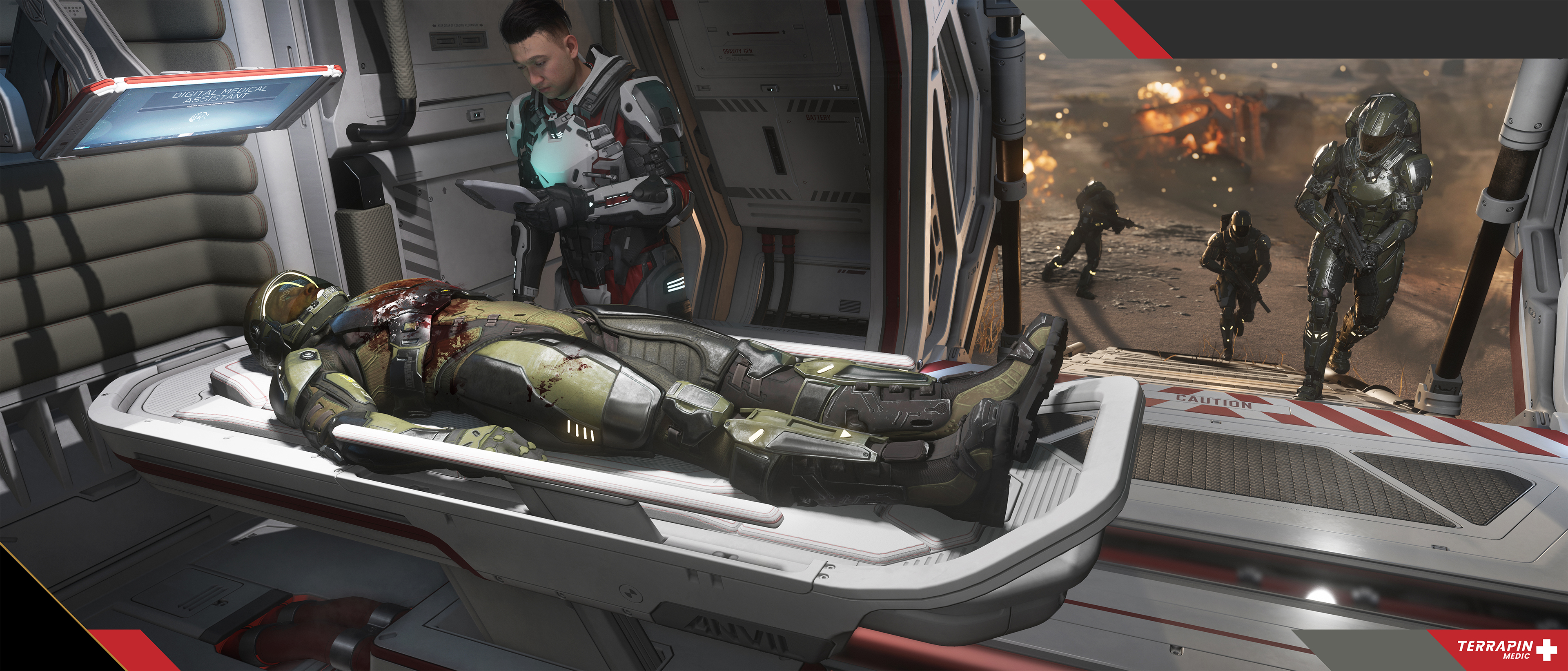
That combination is the reason to consider it. If one injured player needs collection from a difficult location, a compact ship with Tier 2 treatment offers something the Red’s extra bed cannot. The Medic keeps the base Terrapin’s armour and shields. Its protective design is useful reassurance when the route in is unpleasant, though it is no licence to ignore hostile fire or severe weather.
The conversion has real compromises inside. The base ship’s bunk, shower and toilet are gone. Weapon racks and the suit locker give way to a medical preparation area with a sink and supply storage. Personal lockers serve the pilot and patient, but there is no rated cargo grid. Zero SCU does not mean there is nowhere to put a medical item; it means the ship is not offering a freight compartment alongside its rescue role.
Do not choose it expecting the canopy shutters to provide stealth, either. Closing the armour is not a documented signature-reduction feature. Nor can the emergency beacons on top be exchanged for a rescue tractor mount. The Medic is already useful on its own terms without borrowing capabilities from a future wish list.
For a solo responder, its appeal is easy to understand: a manageable hull and stronger treatment capability for the patient you have just collected. For a squad with several casualties, the single bed becomes the trade-off. If you need a ship to live aboard between jobs, the removed amenities deserve just as much attention as the medical upgrade.
Find your Terrapin Medic at The Impound.
Apollo: choose the ward before you leave
The Apollo is where rescue support becomes a much more deliberate operation. Both the Triage and Medivac are flight ready, both carry 32 SCU of cargo, and both use the same two-slot medical-bay system. Their treatment potential comes from the modules you fit, not from choosing the more heavily protected variant.
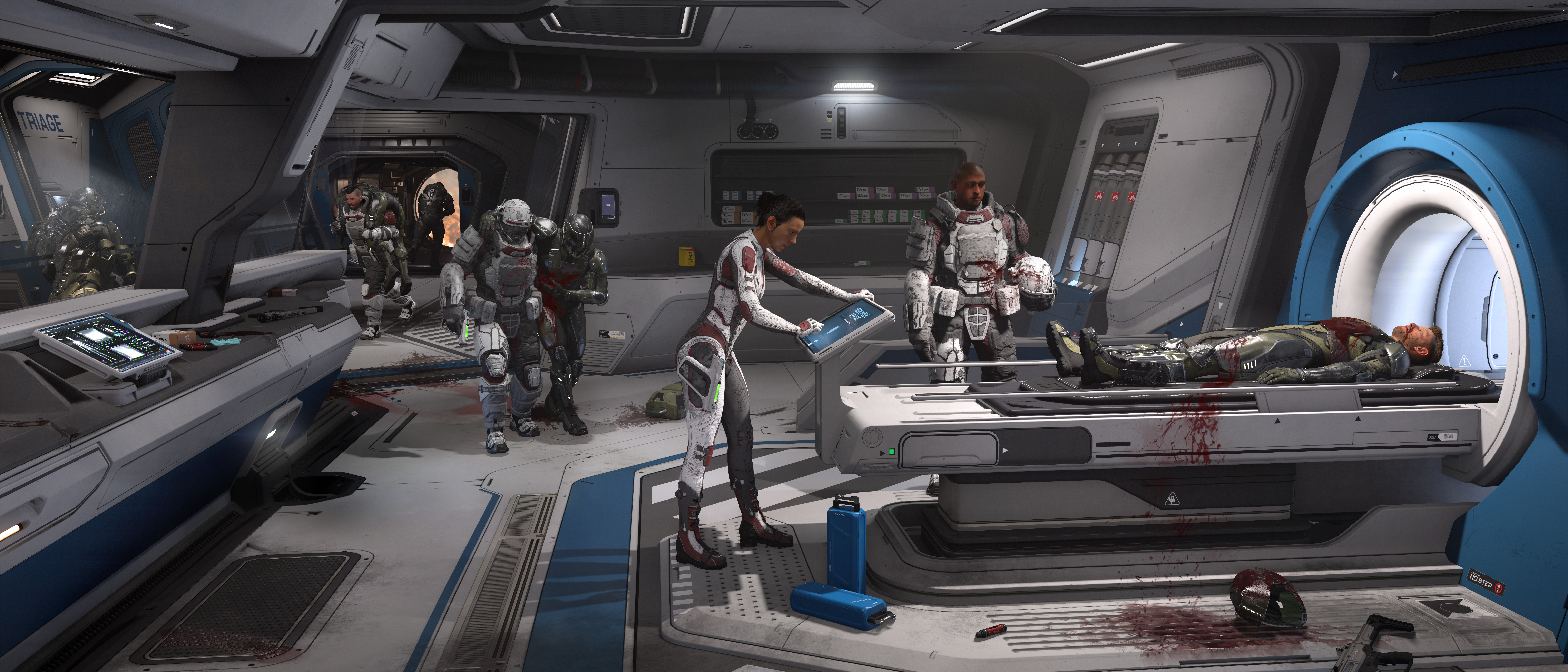
Each module slot can hold three Tier 3 beds, two Tier 2 beds or one Tier 1 bed. Fit the same module on both sides and the ship offers six basic beds, four intermediate beds or two beds capable of treating the most severe injuries. Mix the bays and you can keep a severe-injury facility aboard while retaining several beds for less serious casualties.
| Left bay | Right bay | Result aboard |
|---|---|---|
| Tier 3 module | Tier 3 module | Six Tier 3 beds |
| Tier 2 module | Tier 2 module | Four Tier 2 beds |
| Tier 1 module | Tier 1 module | Two Tier 1 beds |
| Tier 1 module | Tier 3 module | One Tier 1 bed and three Tier 3 beds |
| Tier 1 module | Tier 2 module | One Tier 1 bed and two Tier 2 beds |
| Tier 2 module | Tier 3 module | Two Tier 2 beds and three Tier 3 beds |
A pair of Tier 1 modules is tempting because it gives the highest treatment capability, but it also gives the fewest beds. A group expecting several minor casualties may get more use from a higher-capacity layout. An expedition travelling far from a hospital has a stronger reason to reserve at least one bay for severe injuries. The useful question is how many patients you expect to handle, and what condition they are likely to be in.
Both variants start with two Tier 3 modules in the factory arrangement described at launch. For a particular ship offer, check the listed contents rather than assuming every acquisition route includes every alternative module. Once aboard, the medical spaces include dedicated MedGel storage, and the Apollo has two rack areas for weapons and utility equipment. That makes the ship easier to organise around a crew actively treating patients while the pilot handles the journey.
Triage or Medivac?
The Triage is the straightforward medical platform. The Medivac adds enhanced armour and expanded missile capacity for more hazardous rescue work. Both can fit the same bed modules, and paints are compatible across the pair. Paying attention to the destination is more useful here than treating one name as a better hospital: a Medivac with basic beds cannot heal a severe injury merely because it has a more combative specification.
We would lean towards the Medivac for a crew specifically building around contested extractions, and towards the Triage when treatment and transport are the main attraction. Neither can shrug off concentrated fire. An escort, a sensible landing position and someone ready to receive the casualty still do work that armour cannot.
Explore Apollo Triage offers or Apollo Medivac offers at The Impound.
Which one would we take?
For a small group that needs a useful support ship between rescues, the Cutlass Red is the easiest recommendation. Its two beds and cargo space suit mixed outings, provided the crew accepts the limits of Tier 3 treatment. It is also the one to consider when two lightly injured friends are a more likely problem than one patient needing advanced care.
For a responder concentrating on individual extractions, the Terrapin Medic has the stronger case. Its smaller hull and Tier 2 bed make a compelling pairing. You give up a second bed, rated freight capacity and living amenities, so it should be chosen for rescue work rather than as an all-purpose home.
For a dedicated medical crew, the Apollo’s configurable bays are the real attraction. It can serve several patients or carry Tier 1 treatment into the field. A solo owner can fly it, but having a second person available for casualty handling makes much better use of the space while the pilot remains at the controls.
Whichever ship you bring, keep its medical supplies and imprint requirements in mind. A bed’s treatment tier, regeneration reach and remaining MedGel are separate considerations. Our medical beds and regeneration guide explains those mechanics; the C8R Pisces and Ursa Medivac comparison covers smaller support options. Choose the ship that gets the right care to your crew, and leave room in the plan to get everyone home.

Bring your crew home
Find the medical ship for your next rescue at The Impound.
Browse medical ships