


























Pulse vs Dragonfly vs Nox: Which Star Citizen Hoverbike Fits Your Trips?

Passenger space, compact transport and alien racing style: a practical comparison of the Pulse, Pulse LX, Dragonfly and Nox.
A tiny Mirai that can travel with your ship, a Drake with room for company, or an Aopoa racer that looks like nothing built on Earth.
A hoverbike is an excuse to get out of the cockpit. There is a particular appeal to leaving a ship behind and crossing a stretch of landscape with the ground rushing past beneath your boots. The difficult part is choosing the bike you will actually bring along, rather than the one that looks best sitting in a hangar.
The Mirai Pulse, Drake Dragonfly and Aopoa Nox approach that job differently. The Pulse makes a strong case on sheer compactness. The Dragonfly has a passenger seat. The Nox leans into its identity as an alien racer. All three have weapons, but none of those differences can be reduced to a reliable “best bike” ranking from an advertised speed number.
Start with the passenger seat
If two of you want to travel on one bike, the Dragonfly has the most decisive advantage in this comparison: its second seat faces backwards, behind the pilot. A friend can come along without bringing a second vehicle. It is a small detail when browsing a catalogue and a much bigger one when planning an evening together.
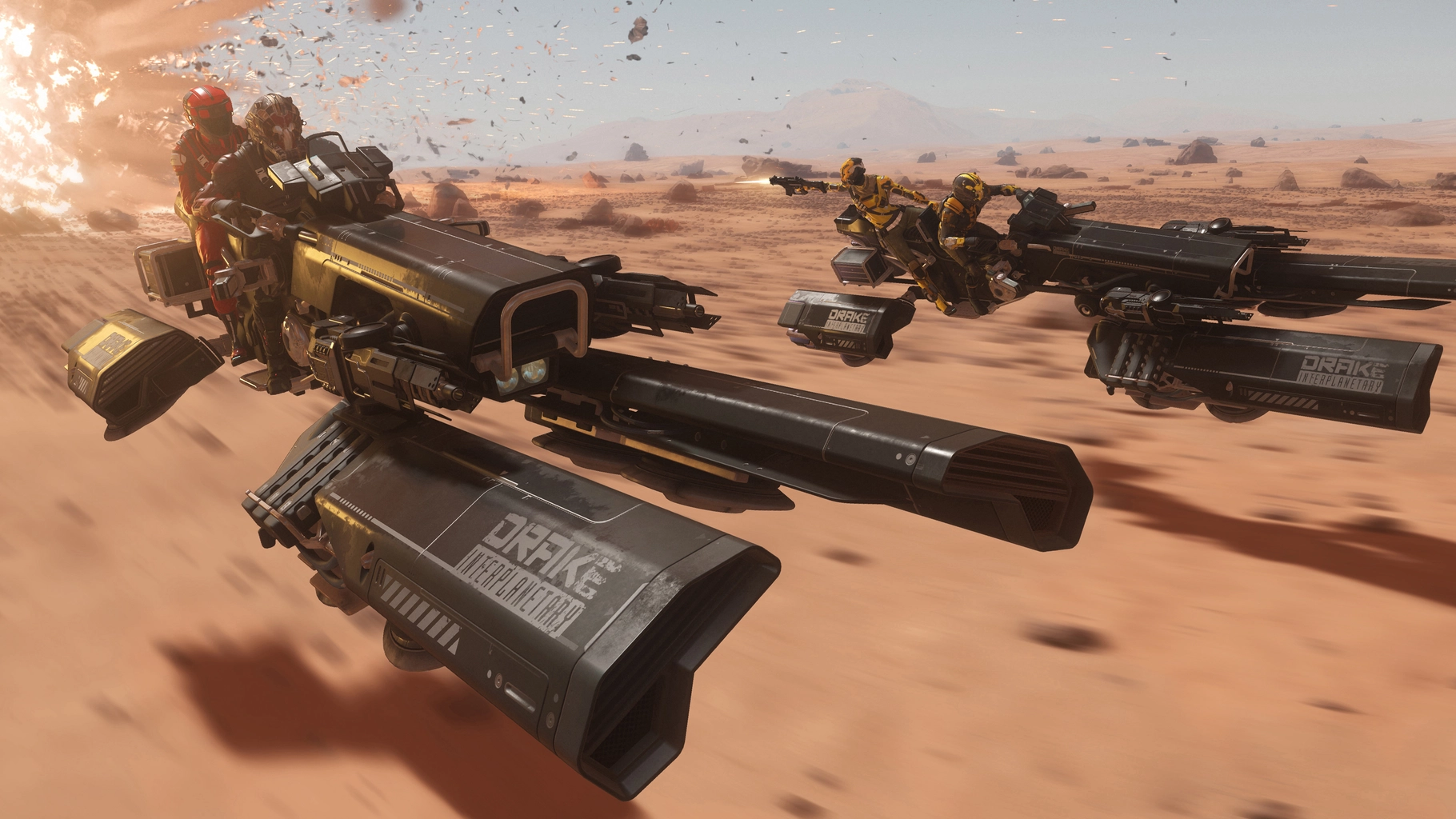
Drake’s current description calls the Dragonfly a two-seat hoverbike, even though the same page’s crew field says one. That crew field should not be read as the number of seats: the passenger is explicitly part of the vehicle’s description. The Pulse and Nox are single-rider choices.
The Dragonfly also occupies considerably more room. Its listed length is 7 metres, against 3.5 metres for the Pulse. That does not prove either will fit through a particular ramp or doorway, but it explains why a Dragonfly is a bigger commitment inside a small ship. Space needed to walk around it matters too, especially if the cargo hold is also the route to your cockpit.
There is plenty of Drake character in that trade. You get a long, exposed machine with a companion behind you and a pair of Size 1 weapon mounts up front. It is easy to imagine it as the bike a crew keeps aboard for trips away from the landing zone. Choose it for that shared ride, rather than assuming its weapons make it a substitute for an armoured ground vehicle.
The Pulse earns its place by being small
Mirai’s compact chassis is the Pulse’s strongest everyday selling point. A bike is much more useful if bringing it does not dominate the ship around it. Its small footprint gives it a persuasive role as a solo pilot’s extra set of wheels—or, in this case, grav-lev thrusters.
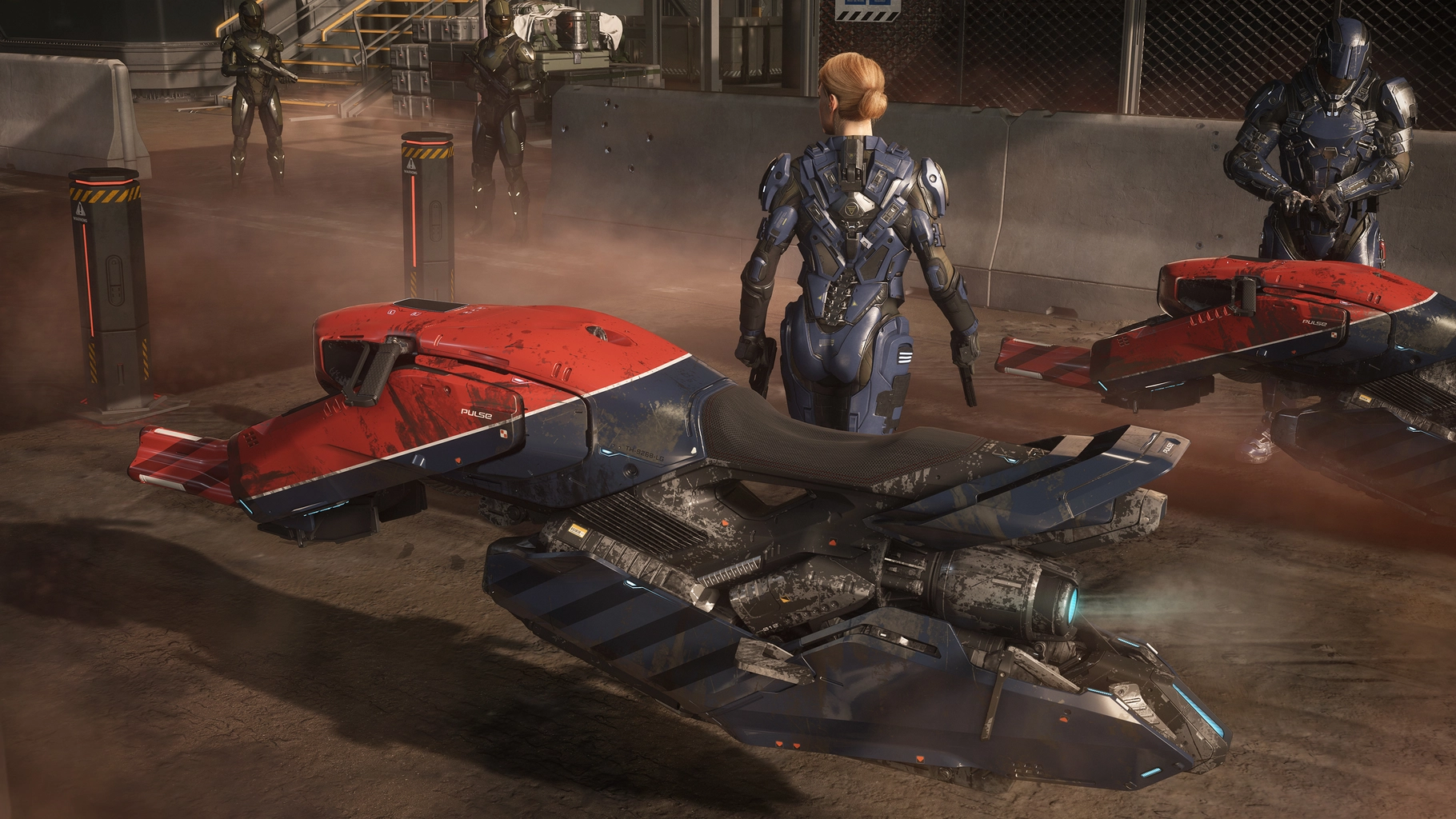
The base Pulse carries one bespoke, gimballed Size 2 laser Gatling. The weapon is fixed to that design rather than being a mount for any Size 2 ship gun you fancy. There is a small personal storage space, but no weapon rack. Those are useful distinctions for someone arriving with a rifle, a backpack and a plan to spend time away from the ship.
The Pulse LX makes a different bargain: it removes the gun in favour of an intake and two additional rear thrusters. Pick the armed Pulse if you want the weapon; consider the LX if the attraction is the racer itself. Neither an old quoted top speed nor the number of thrusters is enough to establish which will be faster over your particular route.
Mirai’s design Q&A also explains the weapon’s Xi’an connection: it comes from Torral Aggregate. That makes the little bike an interesting companion to the human–Xi’an technology story, with the collaboration extending beyond the hovering chassis into the equipment attached to it.
The Nox is the one for the alien-bike obsession
The Nox has a lovely, improbable shape: a narrow rider position enclosed by long, sweeping bodywork. It feels visually closer to something that has slipped out of a science-fiction chase scene than a utility vehicle. That is a perfectly good reason to want one, provided the job you need it to do fits the design.
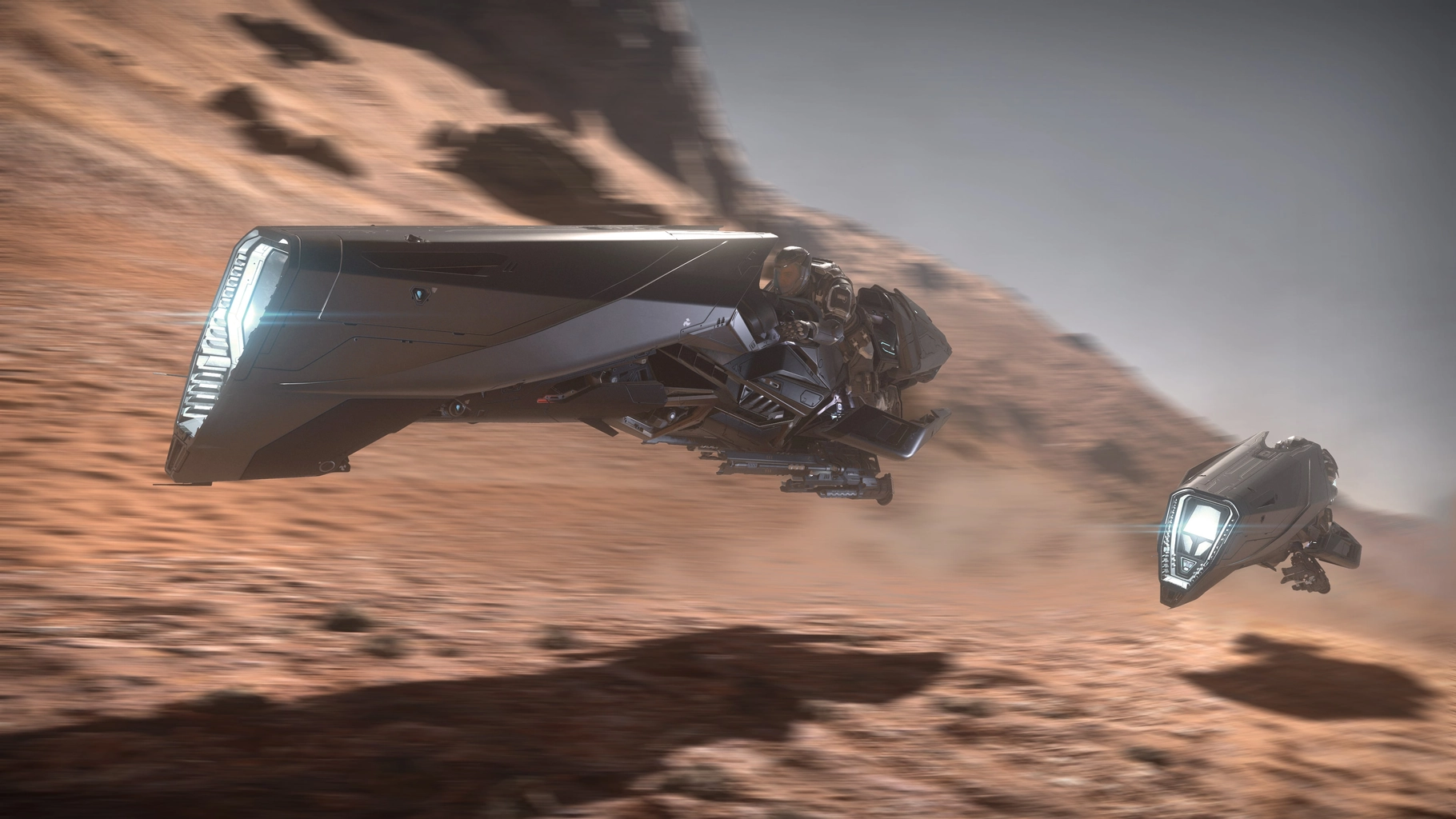
Aopoa brought a version adapted for human riders into human space in 2947. Its racing focus remains central to the current vehicle description, and its equipment list shows a pair of Size 1 weapons. Unlike the Dragonfly, it is not offering a second seat as part of the deal.
The original Nox Q&A positioned it as the more racing-focused choice beside the utility-minded Dragonfly, while acknowledging that rough terrain could favour the Drake. That is useful design context, not a current-build lap-time result. A bike’s stability, the route and the rider all matter, and we would not turn a 2017 answer into a promise that the Nox wins every race today.
The same early Q&A describes no small-item compartment or rifle storage. For a carrying-heavy trip, do not choose it on the assumption that the streamlined bodywork conceals luggage space. The current ship page lists no cargo capacity either.
Equipment at a glance
| Bike | People aboard | Weapon arrangement | Main reason to choose it |
|---|---|---|---|
| Pulse | One rider | One bespoke Size 2 laser Gatling | Compact armed transport |
| Pulse LX | One rider | Unarmed racing variant | Dedicated Mirai racer |
| Dragonfly | Pilot and rear-facing passenger | Two Size 1 mounts | Taking a friend on one bike |
| Nox | One rider | Two Size 1 mounts | Aopoa styling and racing focus |
Getting the bike to the place you want to ride
Think about the ship carrying it before committing to the bike. A cargo capacity in SCU is not a doorway measurement. Ramps, internal turns, ceiling clearance and the space required to mount or dismount can all make a generous-looking hold awkward in practice.
The Pulse is the obvious starting point where space is tight. A Dragonfly makes more sense when the passenger seat earns its larger footprint. The Nox is for the rider who wants that particular machine enough to give it room. Those are reasons to narrow a choice, not guarantees of fit in an unnamed carrier.
Space operation needs a little care in the terminology too. The Nox and Dragonfly were designed for both surface travel and use in space; that does not make them independent planet-to-orbit spacecraft. The Nox Q&A explicitly distinguishes riding in either environment from making the transition under its own power. Their current specifications list no quantum drive, as does the Pulse’s.
For wider transport planning, use The Impound’s Ship Matrix alongside the actual access layout of your carrier. If your trip calls for protection, cargo or an enclosed cabin, it may be a rover you want rather than a bike at all.
Which would we put aboard?
For a solo pilot who wants a compact armed runabout, we would start with the Pulse. For two friends sharing one vehicle, the Dragonfly’s passenger seat is worth more than an abstract performance comparison. For someone who has fallen for the Nox’s design and wants a single-seat racer, the Aopoa has an appeal the more practical arguments will never quite replace.
Choose around the trip you are excited to take. A bike that leaves enough room for the rest of your evening—and the people coming with you—is a better companion than a theoretical winner you never unload.