


























RSI’s Origins: Quantum Travel, Mars and the Messer Years

The first human quantum drive, a failed Martian atmosphere and a hostile Empire shaped Roberts Space Industries long before today’s fleet.
Before there was a Constellation, before the Bengal carried a fleet's worth of fighters, Roberts Space Industries was trying to solve problems much closer to the ground. Its history begins on Earth, with practical inventions and an ambition that its first products could not yet fulfil.
Nearly a millennium later, the RSI name belongs on tiny personal ships, enormous naval carriers and the technology that helped humanity leave its home world. That range is what makes the manufacturer interesting. Its early centuries brought extraordinary engineering, a disastrous attempt to make another planet habitable, and a struggle to survive an Empire that preferred a rival shipbuilder.
This is the history of Roberts Space Industries inside the Star Citizen universe: the company founded in 2038, rather than the real-world development history of Cloud Imperium Games.
2038–2075: an Earthbound beginning
Chris Roberts founded RSI in 2038. The company's first release, in 2043, was an efficient battery converter for civilian ground vehicles. Water purification, power networks and even cricket farming followed. In 2061, Roberts found Dr Scott Childress's work on more affordable spacecraft engines and assembled a team around it.
The breakthrough came in 2075. Childress and his team produced humanity's first self-sustaining quantum-drive engine, capable of one per cent of the speed of light. Sol suddenly became a place people could explore on a radically different timetable.
One of the loveliest details in this early history comes from Childress's daughter Rebecca. Her childhood diary remembers seeing her father on a broadcast beside the President, complete with a beard grown during his time away. The scientific achievement is enormous; her recollection is of an absent parent suddenly appearing on the screen. It gives the invention a human cost before the later histories turn it into a date.
The distinction also keeps RSI's achievement in perspective. Humanity was not the first civilisation to invent quantum travel: the Xi'an had developed it thousands of years earlier. RSI's place in this story is the transformation of human travel, rather than a claim to have invented the technology for the entire universe.

2113–2157: a new atmosphere, and a terrible failure
A faster engine could take people away from Earth. Terraforming offered the possibility of somewhere else to live. Roberts died in 2108, before the work reached its breakthrough, but RSI continued the project. In 2113, the company introduced technology capable of altering a planet's atmosphere into an environment that could sustain human life.
The idea was controversial from the beginning. A contemporary fictional editorial by Hannigan Terrell objected to the assumption that the ability to remake a world gave humanity the right to do so. His argument is part of the setting's history of terraforming: excitement about escape and expansion existed alongside unease about the scale of the intervention.
Mars became the first great demonstration of both the promise and the danger. In 2125, during the closing stages of its conversion, the new atmosphere failed. The contemporary account describes a suspected chemical miscalculation in the atmospheric processors. After two weeks of apparently stable conditions, the personnel on the surface had stopped using the breathing equipment that might have protected them.
The collapse was too fast for alarms and sealed installations to save them. 4,876 people died. That figure deserves to remain part of RSI's history alongside the first engine and the famous ships. Terraforming was not a clean sequence of successful inventions; the people trying to make it work paid an appalling price.
Mars was finally declared capable of sustaining an oxygen atmosphere in 2157. A memorial to those lost in 2125 accompanied the announcement. By then the project had lasted almost forty years. For a reader arriving at Star Citizen through its spacecraft, this is an important part of the wider setting: the habitable worlds of the Empire have histories of engineering, settlement and loss behind them.
The Zeus makes spaceflight personal
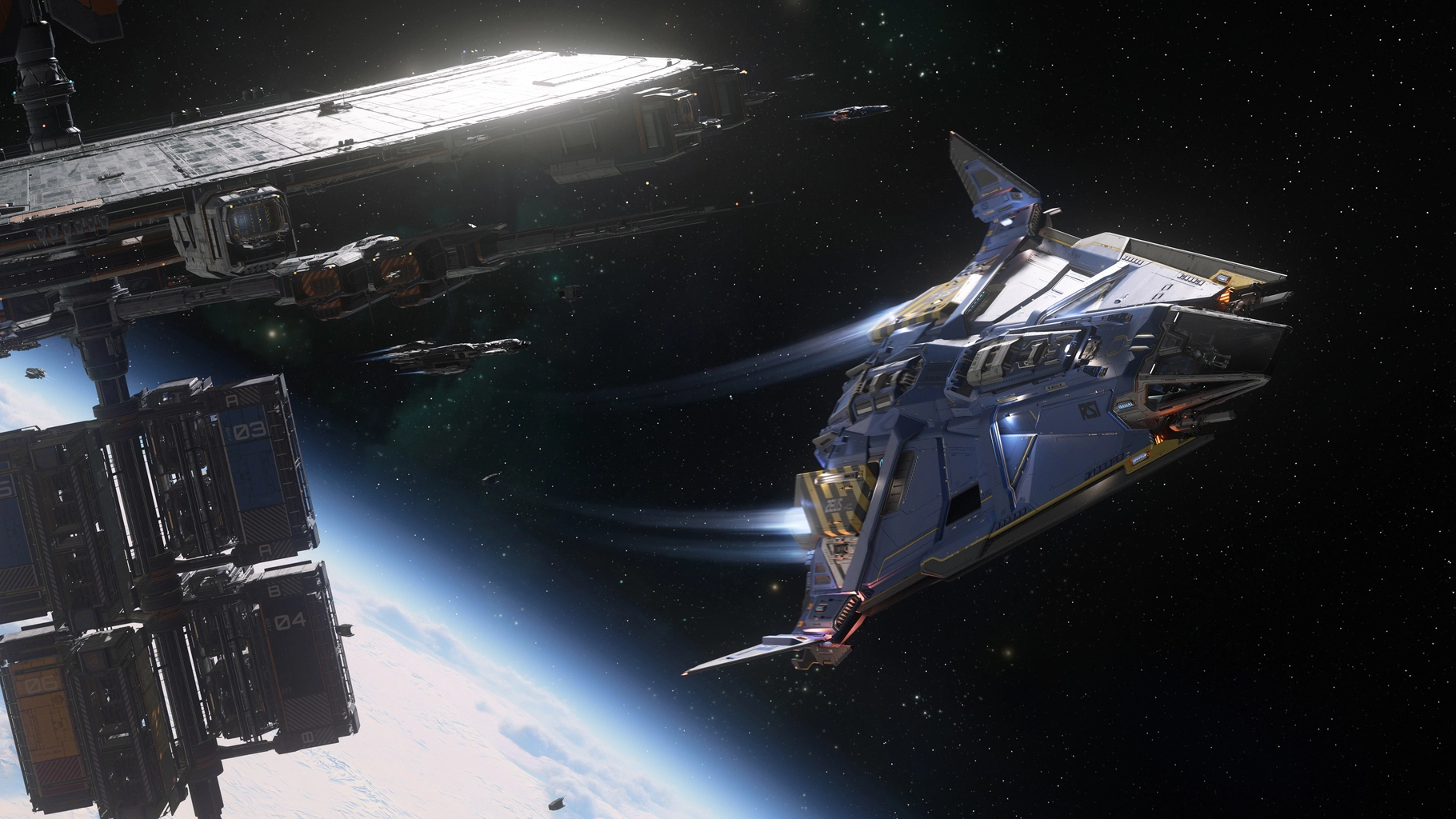
While the Mars project continued, another RSI milestone arrived in 2140: the Zeus. It brought commercially available spacecraft into a world where space travel had largely belonged to governments, corporate fleets and the very wealthy. The everyday owner-pilot—the person who could imagine a ship as their own means of travel—became central to the company's identity.
The original Zeus and the modern Zeus Mk II are separated by centuries. They should not be treated as the same ship with a minor equipment update. The newer family deliberately reaches back to the older name, carrying that association with personal spaceflight into a very different era.
That connection is easy to appreciate in the present fleet. RSI can build a vast warship, but much of its appeal still rests on the idea of taking a manageable vessel out with your own crew. A ship with somewhere to sleep and room for useful work makes the universe feel inhabitable in a way that a distant military flagship cannot.
2214: progress becomes ordinary life
RSI's next-generation fusion engine appeared in 2214. The surviving Time Capsule story tells the event through a school pupil receiving an inconvenient textbook update just before a quiz. It is a small, funny change of scale after the great announcements of the previous century: another advance in space travel has become something a child resents having to study.
That is part of the pleasure of Star Citizen's fictional history. Huge technological changes eventually become the background of ordinary lives. An engine that once demanded a public celebration later belongs in a lesson, just as a spacecraft that once seemed unimaginable can become somebody's daily transport.
The Messer years: the Empire chooses Aegis
RSI's technical importance did not make it politically untouchable. During the Messer Era, military contracts shifted to Aegis Dynamics. RSI declined and became more dependent on civilian and commercial work. The manufacturer behind some of humanity's defining advances could still lose its position when the government favoured someone else.
In 2757, the murder of child labourer Anthony Tanaka helped drive a new wave of opposition to the regime. RSI chief executive Avel Gedima acknowledged the killing and ordered a review of conditions in the company's facilities. Ulysses Messer X then accused him of financial wrongdoing; years of pressure forced his resignation.
The regime eventually fell in 2792. The Anti-Messer Revolution had roots stretching back decades, including anger over Tanaka's death and opposition encouraged by the thaw in relations with the Xi'an. The immediate catalyst was the broadcast of the Massacre of Garron II, which turned dissent into open revolt.
After twenty-two days of unrest, the Messers were removed and Erin Toi became Imperator. RSI's military contracts were restored after the end of the era. Its return to naval work belongs to that political transition, rather than an uninterrupted march from the first quantum engine to the modern carrier fleet.
A reputation to rebuild
Surviving the dictatorship did not settle every question about RSI's conduct. Critics argued that it had failed to use its influence against the regime. The company established the Future Foundation, supporting education, research and housing, and added a commitment to doing good to its founding principles.
RSI emerged with its business intact, but with questions about what a company owed the people living under its government.
A different history beneath a familiar name
It is easy to meet RSI through a Constellation, an Aurora or a page of ship specifications and never encounter the company behind them. Its earlier story is less comfortable than a parade of famous spacecraft. Families waited for engineers working away from home; settlers trusted an atmosphere that failed; executives discovered how little their industrial importance protected them from a dictator.
Those episodes give the later fleet a richer setting. The original Zeus belongs to the dream of ordinary people travelling beyond Earth. The Mars project belongs to the much harder question of how they might live elsewhere. By the time the Messers fell, RSI had helped change both the reach of human civilisation and the worlds it could inhabit.
Our older RSI fleet overview surveys the ships that followed. For the current Constellation generation, the Mk IV refit feature takes you aboard the familiar family after its latest rebuild.